GST 2.0: A Complete Guide to the Latest Rate Changes and Budget 2026 Amendments
The recent Goods and Services Tax (GST) landscape in India has been defined by the “GST 2.0” reforms proposed in the Union Budget 2026 and recommended during the 56th GST Council Meeting. These amendments focus on simplifying the tax structure, easing compliance for exporters, and strengthening digital enforcement.
1. Major Rate Rationalization (GST 2.0)
Effective from September 22, 2025, the previous multi-slab system was simplified into a cleaner four-slab framework to reduce classification disputes:
* 0% (Exempt): Covers essentials like unbranded dairy, 33 lifesaving drugs (e.g., cancer medications), and educational materials. Notably, individual life and health insurance are now exempt.
* 5% Slab: Includes common goods like packaged food, toothpaste, soap, and bicycles. Many items previously at 12% were moved here.
* 18% (Standard Rate): The new default rate for most goods and services, including consumer electronics, small cars, and standard restaurant dining.
* 40% (Luxury/Sin Slab): Replaces the 28% + Cess structure for premium cars, aerated beverages, and online gaming. Tobacco and cigarettes transitioned to this slab (18% or 40%) in February 2026 with the elimination of the Compensation Cess.
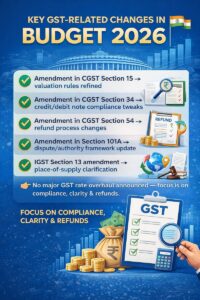
2. Key Procedural Amendments (Budget 2026)
The Finance Bill 2026 introduced several structural changes to the CGST and IGST Acts:
* Post-Sale Discounts (Sections 15 & 34): Businesses no longer need a pre-existing agreement to claim GST benefits on discounts. Discounts can be excluded from taxable value as long as a credit note is issued and the recipient reverses the related Input Tax Credit (ITC).
* Intermediary Services (Section 13 IGST): The “place of supply” for intermediary services is now the recipient’s location. This allows these services to qualify as exports (zero-rated), providing massive relief to the IT/ITES sector.
* Refund Reforms:
* Provisional Refunds: Now extended to taxpayers with an inverted duty structure, allowing for 90% provisional refunds to improve cash flow.
* Threshold Removal: The ₹1,000 minimum limit for sanctioning export refund claims has been removed for exports made with tax payment.
3. Compliance and Portal Enforcement
The GST portal has transitioned from warnings to “hard validations” starting January 2026:
* GSTR-3B Blocking: The portal now blocks filing if the reported ITC does not match the eligible balances in GSTR-2B.
* Bank Account Mandate: Failure to furnish bank details within 30 days of registration now leads to automated suspension of the GSTIN.
* Time-Bar on Returns: Taxpayers are permanently barred from filing any return (GSTR-1, 3B, 9) that is more than three years past its due date.
* Invoice Management System (IMS): A new “Import of Goods” section was added to the [GST Portal](https://www.gstn.org.in/) to track Bill of Entry (BoE) details for ITC claims.
4. Dispute Resolution
* Interim Appellate Mechanism: A new sub-section in Section 101A empowers the government to authorize existing authorities to hear appeals until the National Appellate Authority (NAA) is fully functional.
* GSTAT Operationalization: The [Goods and Services Tax Appellate Tribunal (GSTAT)](https://gstcouncil.gov.in/) began accepting appeals in late 2025 to reduce high-court litigation.
