EPF wage ceiling 25000: Effective Date, Pension & Take-Home Impact
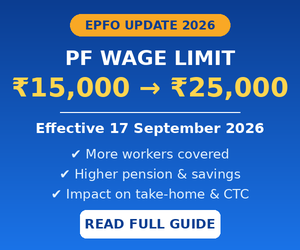
Quick summary: The EPF wage ceiling for mandatory Provident Fund coverage has been raised from ₹15,000 to ₹25,000 per month, effective 17 September 2026. More employees now come under EPF, EPS (pension) and EDLI (insurance) coverage. Contribution rates are unchanged, but the wage base is higher, so take-home pay may fall for some employees while retirement savings rise.
In this article
- What has changed in the PF wage ceiling
- Why the limit was raised
- When it comes into effect
- Who is affected (category-wise)
- Key structural impact
- New contribution table (from October 2026)
- Impact on pension (EPS) and insurance (EDLI)
- Impact on take-home pay and CTC
- Action points for employees and employers
- FAQs
1. What Has Changed in the Provident Fund Wage Limit?
On 16 September 2026, the Union Cabinet approved the Ministry of Labour & Employment’s proposal to raise the wage ceiling for mandatory EPFO coverage from ₹15,000 to ₹25,000 per month. The Ministry then notified the change through S.O. 5109(E), issued under the Code on Social Security, 2020. This is the first revision in 12 years. The ceiling was last raised in September 2014, from ₹6,500 to ₹15,000.
Put simply, the ceiling is the maximum monthly wage (basic pay plus dearness allowance) used to decide who must join EPF and on what amount contributions are calculated. It is not your total salary or CTC.
| Particulars | Until 16 Sep 2026 | From 17 Sep 2026 |
|---|---|---|
| Wage ceiling (per month) | ₹15,000 | ₹25,000 |
| Mandatory coverage | Wages up to ₹15,000 | Wages up to ₹25,000 |
| Employee contribution | 12% | 12% (unchanged) |
| Employer contribution | 12% | 12% (unchanged) |
| Maximum EPS contribution (8.33%) | About ₹1,250 | About ₹2,083 |
| Last revised | September 2014 | 17 September 2026 |
2. Why Was the PF Limit Increased?
- The ₹15,000 ceiling stayed unchanged for 12 years even as wages and minimum wages rose across states and sectors.
- Many employees earning just above ₹15,000 were left outside mandatory PF, pension and insurance protection.
- Trade unions and employer representatives had highlighted that the old limit excluded a large section of formal workers.
- The new limit brings the threshold closer to present wage levels and extends social security to more workers and their families.
3. When Will It Come Into Effect?
The new ceiling is effective from 17 September 2026, the date of publication in the Official Gazette (coinciding with Vishwakarma Jayanti, as noted by the Labour Minister). Because it began in the middle of the month, September 2026 payroll needs a split calculation:
- 1 to 16 September: contributions calculated on the old ₹15,000 ceiling.
- 17 to 30 September: contributions calculated on the new ₹25,000 ceiling, pro-rata.
- October 2026 is the first full month at the new ceiling, so higher deductions will be clearly visible on the October payslip.
| Date | Event |
|---|---|
| September 2014 | Ceiling raised from ₹6,500 to ₹15,000 |
| 16 September 2026 | Union Cabinet approves hike to ₹25,000 |
| 17 September 2026 | Gazette notification S.O. 5109(E); new ceiling effective |
| 1 October 2026 | First full wage month at ₹25,000 ceiling |
4. Who Is Affected? (Category-Wise)
| Employee category | What it means |
|---|---|
| Not a PF member, wages ₹15,001 to ₹25,000 | Newly covered. Mandatory EPF, EPS and EDLI from 17 Sep 2026. |
| Existing member, wages above ₹15,000, contribution capped at ₹15,000 | Higher contribution base of up to ₹25,000. Deduction rises by up to ₹1,200 a month. |
| Existing member already contributing on actual basic + DA | Total PF outgo largely unchanged. The employer share is re-split, with more going to EPS and less to EPF. |
| Wages above ₹25,000, not a PF member | No change. Remains an excluded employee, though voluntary coverage is possible with employer consent. |
| Existing member, wages up to ₹15,000 | No change. |
The government estimates that more than 51 lakh additional employees will come under mandatory EPFO coverage, mainly in sectors such as retail, logistics, hospitality, small manufacturing, IT services and education.
5. Key Structural Impact
Expanded Coverage and Access to Pension
Before this change, a new joiner earning above ₹15,000 could be kept out of EPS and the mandatory framework. Now, employees in the ₹15,000 to ₹25,000 band get access to a provident fund corpus, the Employees’ Pension Scheme and EDLI life insurance. This widens the social security net for millions of workers and their families.
Reduced Take-Home Pay
Since 12% is calculated on a higher wage base, the employee deduction rises from a maximum of ₹1,800 to ₹3,000 per month. For newly covered employees, monthly in-hand salary can fall by up to ₹1,200.
Higher Savings for Retirement
The reduction in take-home is not a loss. The employee’s 12% and the employer’s matching share go into the EPF account and EPS, earning interest and compounding over the years. Total monthly retirement-related contribution at the ceiling rises from ₹3,600 to ₹6,000.
CTC and Salary Structure Changes
The employer’s share is usually part of CTC. With a larger wage base, employer cost rises, including 0.5% EDLI and 0.5% admin charges. Companies may respond by re-cutting salary components (basic, allowances, special pay) or adjusting the gross-to-CTC split. Employees should ask HR for a revised salary structure and confirm how PF wages are defined in their offer letter.
6. New Contribution Table (From October 2026)
| PF wages | Employee EPF 12% | Employer EPS 8.33% | Employer EPF 3.67% | EDLI 0.5% | Admin 0.5% |
|---|---|---|---|---|---|
| ₹10,000 | ₹1,200 | ₹833 | ₹367 | ₹50 | ₹50 |
| ₹15,000 | ₹1,800 | ₹1,250 | ₹550 | ₹75 | ₹75 |
| ₹20,000 | ₹2,400 | ₹1,666 | ₹734 | ₹100 | ₹100 |
| ₹25,000 | ₹3,000 | ₹2,083 | ₹917 | ₹125 | ₹125 |
Illustrative figures based on the standard contribution split. EDLI and admin charges are paid by the employer over and above the 12% share.
Before vs After at ₹25,000 PF Wages
| Monthly item | ₹15,000 ceiling | ₹25,000 ceiling |
|---|---|---|
| Employee PF deduction | ₹1,800 | ₹3,000 |
| Employer PF share (12%) | ₹1,800 | ₹3,000 |
| Total into retirement savings | ₹3,600 | ₹6,000 |
| Employer total cost incl. EDLI + admin | ₹1,950 | ₹3,250 |
| Fall in take-home (newly covered / previously capped) | — | Up to ₹1,200 |
7. Impact on Pension (EPS) and Insurance (EDLI)
Employees’ Pension Scheme (EPS)
The employer’s EPS contribution is 8.33% of pensionable wages, capped at the ceiling. It rises from about ₹1,250 to about ₹2,083 a month on a full ₹25,000 ceiling. Newly covered employees in the ₹15,000 to ₹25,000 band can now qualify for EPS. Please note:
- Pension is calculated under EPS rules, based on pensionable salary and service, not simply by applying today’s ceiling to your whole past career.
- Existing members who were earlier classified as “EPS – No” are not automatically converted to “EPS – Yes”. Their status depends on earlier membership and any further EPFO instructions.
- Employees earning above ₹25,000 are not automatically covered under EPS, though they may contribute to PF on higher wages by agreement with the employer.
Employees’ Deposit Linked Insurance (EDLI)
EDLI gives life insurance benefit to the family if a member dies in service. Its premium (0.5%, paid by the employer) is calculated on the wage ceiling, so it rises with the new limit. Some analysts estimate that the maximum benefit could go up to around ₹10.5 lakh under the existing formula, but this is indicative only and depends on formal scheme amendments. Check EPFO circulars for confirmation.
8. Impact on Take-Home Pay and CTC
- Newly covered or previously capped employees: take-home may fall by up to ₹1,200 a month.
- Employees already on actual-wage PF: little or no change in take-home, but the employer’s share is split differently between EPS and EPF.
- Employers: higher statutory cost, which may lead to revised CTC structures or slower increments in some cases.
- Tax: PF has tax rules of its own (for example the employee contribution qualifies under Section 80C in the old regime, and limits apply to tax-free employer contributions). Consult a tax professional for your case.
9. What Should You Do Now?
For Employees
- Check your September and October 2026 payslips for the revised PF deduction.
- Ask HR whether your CTC or salary structure has changed.
- Make sure your UAN is active, Aadhaar-linked and KYC is complete.
- Verify your EPS membership status in the EPFO member passbook.
- Revise your monthly budget for lower take-home pay.
For Employers and HR Teams
- Update the statutory wage ceiling in payroll software to ₹25,000 effective 17 September 2026.
- Run split-month calculations for September 2026.
- Enrol newly eligible employees, generate or link UANs and collect Form 11.
- Review existing members whose contributions were capped at ₹15,000.
- Communicate the change to staff in advance and follow EPFO circulars for return filing.
10. Frequently Asked Questions (FAQs)
Q1. What is the new EPF wage ceiling?
₹25,000 per month, up from ₹15,000, effective 17 September 2026.
Q2. Has the PF contribution rate changed?
No. It remains 12% for the employee and 12% for the employer. Only the wage base has changed.
Q3. Will the whole of my gross salary now be subject to PF?
No. The ceiling applies to PF wages (generally basic plus DA), not your gross salary or CTC.
Q4. Will my take-home salary reduce?
It may, by up to ₹1,200 a month, if your PF wages are between ₹15,000 and ₹25,000 and you were not contributing on the full amount earlier.
Q5. I earn more than ₹25,000. Does this affect me?
Mandatory coverage does not extend to you on this basis. Voluntary PF membership is possible with employer consent.
Q6. How will September 2026 PF be calculated?
In two periods: ₹15,000 ceiling up to 16 September and ₹25,000 ceiling from 17 September, pro-rata.
Q7. Is the extra deduction a loss?
No. It is credited to your EPF account and earns interest, and the employer’s contribution is added to it.
Q8. Will my pension automatically increase?
Not automatically. Pension depends on EPS rules, your pensionable salary and years of service.
Conclusion
The move from ₹15,000 to ₹25,000 is one of the most significant social security changes in over a decade. It widens PF, pension and insurance coverage, raises long-term savings and pushes employers to revisit payroll and CTC structures. In the short term, some employees will see a smaller monthly payout, but in the long run their retirement corpus will be stronger. Keep an eye on official EPFO circulars for further operational details.
Sources: Press Information Bureau (Cabinet note), Ministry of Labour & Employment Gazette Notification S.O. 5109(E), EPFO FAQs and press coverage from Business Standard and BusinessToday.
Disclaimer: This post is for general information only and is not legal, tax or financial advice. Rules may be clarified by EPFO through further circulars. Please refer to official notifications or consult a qualified professional for your specific situation.
