New ITR Forms AY 2026-27: Key Changes, Mandatory Disclosures & Filing Guide
NEW ITR FORMS FOR AY 2026-27 (FY 2025-26)
Complete Guide to Key Changes, Mandatory Disclosures & Critical Reporting Columns
Published: July 2026 | Category: Income Tax | Applicable: All Indian Taxpayers
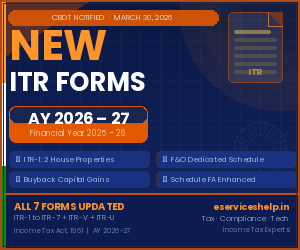
📌 Quick Summary:CBDT notified all ITR forms (ITR-1 to ITR-7) on March 30, 2026 via the Income-tax (Sixth Amendment) Rules, 2026 — ahead of schedule. A corrigendum followed on April 10, 2026. These forms cover income earned in FY 2025-26 and are still governed by the Income Tax Act, 1961 (not the new Act, 2025, which applies from AY 2027-28 onwards).
1. Which ITR Form Should You File for AY 2026-27?
| ITR Form | Who Should File | Key Change AY 2026-27 |
|---|---|---|
| ITR-1 (Sahaj) | Salaried; income ≤ ₹50L; up to 2 house properties; no capital gains exceeding ₹1.25L | Now covers 2 house properties (earlier: 1) |
| ITR-2 | Individuals/HUF with capital gains, foreign assets, >2 house properties | New buyback schedule; simplified single capital gains table |
| ITR-3 | Business/profession (actual books); partners in firms; F&O traders | Dedicated F&O disclosure; extended due date Aug 31 |
| ITR-4 (Sugam) | Presumptive income (44AD/44ADA/44AE); ≤ ₹50L; up to 2 house properties | Declared profit % field; 2 house properties allowed |
| ITR-5 | Firms, LLPs, AOPs, BOIs, cooperative societies | Updated Schedule FA, FSI; angel tax fields removed |
| ITR-6 | Companies (other than those claiming Section 11 exemption) | Buyback capital gains schedule; updated TDS section codes |
| ITR-7 | Trusts, political parties, research institutions | Enhanced donation traceability; Section 80G reform |
2. Key Changes in ITR-1 (Sahaj) — AY 2026-27
ITR-1, popularly called ‘Sahaj’, has received the most taxpayer-friendly upgrade in years. This change directly benefits millions of salaried individuals who were previously pushed to the more complex ITR-2 simply because they owned a second property.
2.1 Two House Properties Now Allowed
🏠 Big Relief:From AY 2026-27, taxpayers with up to two residential properties — one self-occupied and one rented/vacant — can file the simpler ITR-1 instead of ITR-2. Previously, any second property mandated ITR-2.
- New field added: ‘Amount of rent which cannot be realised’ (unrealised rent disclosure).
- Other ITR-1 conditions remain: total income ≤ ₹50L, no capital gains beyond ₹1.25L threshold, no business/professional income.
- Directors of companies, holders of unlisted equity, and those with foreign assets must still use ITR-2 or higher.
2.2 Aadhaar Number — Mandatory (Not Enrolment ID)
- The 12-digit Aadhaar number is now mandatory for ITR filing.
- Aadhaar Enrolment ID is no longer accepted as a substitute.
2.3 Section 89A Relief Moved Out of ITR-1
- Tax relief under Section 89A (for Indian residents with foreign retirement accounts) has been removed from ITR-1 and ITR-4.
- Taxpayers with such foreign retirement accounts must now file ITR-2 or ITR-3.
2.4 Representative Assessee Field (New)
- A new structured field across all ITR forms captures whether the return is filed by a representative assessee (legal heir, guardian, or trustee).
- Replaces the earlier free-text approach — reduces ambiguity and improves processing accuracy.
✅ Key Tip:If you own two house properties and filed ITR-2 last year only because of the second property, check whether you now qualify for the simpler ITR-1 for AY 2026-27.
3. Key Changes in ITR-2 — AY 2026-27
ITR-2 applies to individuals and HUFs with capital gains, foreign assets, or income from more than two house properties. The form sees several structural improvements this year.
3.1 Simplified Capital Gains Schedule — Dual-Date Split Removed
- In AY 2025-26, capital gains had to be reported separately for transactions before July 23, 2024 and on/after July 23, 2024 — due to the Finance Act 2024 mid-year rate change.
- For AY 2026-27, this dual-date bifurcation is removed. A single, unified capital gains schedule applies for all of FY 2025-26.
- Old rate fields (15% STCG on listed equity, 10% LTCG) have been deleted from the form — the revised rates under Finance Act 2024 apply for the full year.
- Applicable rates: STCG on listed equity — 20%; LTCG under Sec. 112A — 12.5% without indexation (above ₹1.25L).
3.2 New Buyback Capital Gains Schedule
📌 Budget 2026:Buyback income is now taxable as capital gains in the hands of shareholders. A new dedicated line item in the capital gains schedule requires: company name, face value of shares tendered, cost of acquisition, and period of holding. Collect these details from your broker or company’s buyback documents.
3.3 Enhanced Section 80C & HRA Disclosure
- Section 80C: Itemised breakup now required — PPF, LIC, ELSS, ULIP, home loan principal, etc. must be listed separately.
- Section 10(13A) — HRA Exemption: PAN of landlord and rent payment proof (bank transfer reference) are now mandatory disclosures.
3.4 TDS Section Code — New Mandatory Field
- Schedule TDS now requires the specific TDS section under which tax was deducted (e.g., 194I for rent, 194J for professional fees, 194C for contractor payments).
- Enables accurate reconciliation with Form 26AS and AIS — mismatches are now directly flagged.
3.5 Schedule VDA — Virtual Digital Assets (Crypto)
- All cryptocurrency and NFT transactions during FY 2025-26 must be reported in Schedule VDA.
- Required details: asset type, purchase date, cost of acquisition, sale date, sale value.
- Flat 30% tax on gains — losses cannot be set-off against other income or gains.
- Even small trades or transactions resulting in losses must be reported — AIS mismatch triggers scrutiny notice.
4. Key Changes in ITR-3 — AY 2026-27
ITR-3 is the primary form for business/professional income filers, including F&O traders, freelancers, proprietors, and partners in partnership firms.
4.1 Dedicated F&O Trading Disclosure — New Separate Schedule
⚠️ High Scrutiny Area:F&O trading now has a dedicated, separate disclosure for turnover and income within the P&L schedule. The Income Tax Department will match this against broker-reported data in AIS. Discrepancies will trigger notices automatically.
4.2 Extended Due Date — Permanently August 31
- The Finance Act 2026 has permanently extended the non-audit ITR-3 due date to August 31, 2026.
- This is no longer a one-time extension — it is now the statutory due date for non-audit business and professional filers.
- Audit cases: October 31, 2026. Transfer pricing: November 30, 2026.
- Partners whose firm is under tax audit also move to October 31.
📅 Note on Advance Tax:The extended filing deadline does not affect advance tax obligations. Interest under Sections 234B and 234C runs on the four advance tax instalments independently of the filing due date.
4.3 Capital Gains Schedules Updated
- Pre-July 23, 2024 rate references removed — single rate structure for the full FY 2025-26.
- Buyback capital gains (post-Budget 2026) reported in the same schedule as in ITR-2.
5. Key Changes in ITR-4 (Sugam) — AY 2026-27
- Two house properties now eligible — same expansion as ITR-1.
- New ‘declared profit percentage’ field: filers must now state the % of gross receipts declared as profit under presumptive taxation (minimum 8% cash / 6% digital under Section 44AD). Flags below-threshold declarations automatically.
- New column for investments made during the year under Financial Particulars of Business section.
- Unrealised rent field added (same as ITR-1).
- Section 89A relief for foreign retirement accounts moved out — taxpayers with such accounts must use ITR-2/3.
6. Changes in ITR-5, ITR-6 & ITR-7
ITR-5 — Firms, LLPs, AOPs, BOIs
- Angel tax fields removed: Section 56(2)(viib) is abolished from AY 2025-26 — premium on share issuance no longer taxable as income from other sources.
- Schedule FA and FSI updated for expanded foreign asset categories.
- Schedule TDS: specific TDS section codes now mandatory.
ITR-6 — Companies
- New buyback capital gains schedule added.
- Schedule OS updated — angel tax fields removed.
- TDS section codes now mandatory in Schedule TDS.
ITR-7 — Trusts, Political Parties, Research Institutions
- Enhanced donation traceability — more granular disclosure under Section 80G.
- Section 80GGC (political contributions): structured disclosure of donor identity and payment mode.
7. Common Changes Across All ITR Forms — AY 2026-27
| Change | Detail & Impact |
|---|---|
| Representative Assessee Field | Structured field for legal heirs, guardians, and trustees filing on behalf of another — replaces free-text, reduces processing errors |
| Aadhaar Mandatory | 12-digit Aadhaar number mandatory; Aadhaar Enrolment ID no longer accepted |
| TDS Section Code in Schedule TDS | Must specify section (194I, 194J, 194C, etc.) for each TDS credit — improves Form 26AS reconciliation |
| Angel Tax Fields Removed | Section 56(2)(viib) abolished — no premium-on-shares reporting required from AY 2025-26 |
| Old Capital Gain Rate Fields Removed | 15% STCG / 10% LTCG rate fields deleted; Finance Act 2024 revised rates apply for the full year |
| New Tax Regime Toggle — Detailed | Clearer, structured fields for opting in/out of new tax regime; reduces Form 10-IEA confusion |
| Schedule AL Threshold → ₹1 Crore | Assets & Liabilities disclosure now mandatory only if total income exceeds ₹1 crore (raised from ₹50 lakh) |
| AIS/TIS Cross-Validation | All schedules now designed to be cross-validated against Annual Information Statement — any mismatch triggers automatic notice |
8. Foreign Asset Disclosure (Schedule FA) — AY 2026-27
Foreign asset disclosure requirements are among the most consequential compliance obligations in the revised ITR forms. Non-disclosure can attract a flat penalty of ₹10 lakh per assessment year under the Black Money Act, regardless of the asset’s value.
🚨 Critical Compliance:Non-disclosure of foreign assets attracts a flat penalty of ₹10 lakh per assessment year under the Black Money Act, plus imprisonment up to 7 years for wilful evasion. India receives foreign financial data via CRS (Common Reporting Standard) and FATCA before you even file your return.
8.1 Who Must Disclose?
- Resident and Ordinarily Resident (ROR) individuals holding any foreign asset or earning any foreign income — mandatory, regardless of income level.
- Non-residents (NRIs) are not required to disclose foreign assets in their Indian ITR.
- RNOR individuals with foreign assets must disclose in Schedule FA.
- Even a dormant foreign bank account with zero balance and zero income must be reported.
8.2 What Must Be Reported?
- Foreign bank accounts (Table A1), custodial/brokerage accounts (Table A2)
- Equity or debt interest in foreign entities (Table A3)
- Foreign insurance/annuity contracts (Table A4)
- Immovable property outside India
- Financial interests, signing authority in foreign accounts
- Trust interests and any other foreign-sourced income (Part G)
- Cryptocurrency on foreign exchanges — report under A1/A2 or Table G (CBDT position evolving; disclose when in doubt)
8.3 Key Compliance Rules
- Calendar year basis: Report assets held during January 1 – December 31, 2025 (not India’s April–March financial year).
- Currency conversion: Use SBI Telegraphic Transfer (TT) buying rate as on December 31, 2025.
- ITR-1 and ITR-4 do not contain Schedule FA — if you hold any foreign asset, you must use ITR-2 or ITR-3.
- If you originally filed ITR-1 and later realise you hold foreign assets, file a revised return in ITR-2/3 before the deadline.
- File Form 67 separately if claiming Foreign Tax Credit under DTAA.
9. Due Dates for ITR Filing — AY 2026-27
| Taxpayer Category | Due Date |
|---|---|
| Salaried individuals, pensioners (non-business) | July 31, 2026 |
| Non-audit professionals & businesses (ITR-3, ITR-4) | August 31, 2026 ← permanent change via Finance Act 2026 |
| Businesses requiring tax audit (ITR-3, ITR-5, ITR-6) | October 31, 2026 |
| Cases with transfer pricing | November 30, 2026 |
| Revised return (extended via Budget 2026) | December 31, 2026 (12 months from end of FY) |
| Belated return (with fee: ₹1,000 or ₹5,000) | December 31, 2026 |
| ITR-U (Updated Return) — expanded window | Up to 48 months from end of AY (Finance Act 2025 amendment) |
✅ E-Verify Within 30 Days:A return not e-verified within 30 days of filing is treated as if never filed. Use Aadhaar OTP for the fastest e-verification. Verify immediately after filing.
ITR-U (Updated Return) — Additional Tax Rates
- Filed within 12 months: +25% additional tax on shortfall
- 12–24 months: +50%
- 24–36 months: +60%
- 36–48 months: +70%
10. Income Tax Act 2025 vs Income Tax Act 1961 — Which Applies for AY 2026-27?
This is the most common point of confusion this filing season. Here is the definitive answer:
✅ Use Income Tax Act, 1961:for all AY 2026-27 filings. AY 2026-27 covers income earned from April 1, 2025 to March 31, 2026 — a period that falls before the new Income Tax Act, 2025 came into force on April 1, 2026. The Income Tax Department has confirmed this on the e-filing portal. The new Income Tax Act, 2025 will govern returns filed for AY 2027-28 (FY 2026-27) onwards.
- Use old Act section references: 80C, 80D, 24(b), 87A, 44AD, 112A, etc.
- On the e-filing portal, always select Tab 1 (Income Tax Act 1961) for AY 2026-27.
- Do not reference the new Act’s section numbers in any deduction or exemption claim for this year’s return.
11. Pre-Filing Checklist — Documents & Data to Collect
The new disclosure columns demand more supporting data than previous years. Here is a category-wise checklist:
✅ For All Taxpayers
- Form 16 / Form 16A from employer or TDS deductors
- Annual Information Statement (AIS) + Taxpayer Information Summary (TIS) from the e-filing portal
- Form 26AS — reconcile with AIS before filing; explain any mismatch
- 12-digit Aadhaar number (not enrolment ID)
- Bank account details (IFSC, account number) for refund
📈 For Capital Gains Filers
- Broker-issued capital gains statement for FY 2025-26 (equity, F&O, bonds)
- Buyback transaction details: company name, face value, cost of acquisition, period of holding
- Mutual fund LTCG/STCG statement from CAMS or KFintech
- STT paid certificate for listed securities
- Real estate sale documents (sale deed, cost of acquisition, stamp duty)
🏠 For House Property / HRA Claimants
- PAN of landlord — mandatory for HRA exemption claim
- Rent receipts or bank transfer proof showing monthly payments
- For second property: rental income details, loan statement showing interest paid
- Unrealised rent amount (if tenant has not paid and legal proceedings are pending)
💼 For Business / Profession / F&O Filers
- GST returns (GSTR-1, GSTR-3B) — turnover must be reconcilable with ITR income
- F&O trade log from broker with separate turnover and P&L breakup
- Profit % calculation for presumptive income filers under 44AD or 44ADA
- Investment schedule for ITR-4 (new column requirement)
- Books of account (for ITR-3 actual-method filers)
🌍 For Foreign Asset Holders
- Details of all foreign bank accounts, investments, property as of December 31, 2025
- SBI Telegraphic Transfer (TT) buying rate for relevant currencies as on December 31, 2025
- Foreign tax paid statements for Form 67 (if claiming DTAA credit)
- Confirm residential status (ROR, RNOR, NR) before filing
💝 For Donations / Section 80G
- Donation receipts with Form 10BE from eligible institutions
- For Section 80GGC (political contributions): receipt + mode of payment documentation
💻 For Cryptocurrency Traders
- Transaction history from all exchanges (Indian and foreign) — purchase dates, costs, sale dates, proceeds
- Valuation at acquisition for airdrop/staking income
- Foreign exchange account details for Schedule FA (if applicable)
12. Frequently Asked Questions — ITR Filing AY 2026-27
❓ Q1. Can I file ITR-1 if I have LTCG on mutual funds up to ₹1.25 lakh?
Yes. Long-term capital gains under Section 112A up to the ₹1.25 lakh exemption threshold are permissible in ITR-1 from AY 2026-27, provided all other eligibility conditions are met. Capital gains beyond this threshold require ITR-2.
❓ Q2. I own two self-occupied properties. Can I file ITR-1?
Yes, from AY 2026-27, ITR-1 is eligible if your total income is ≤ ₹50 lakh, you have no other disqualifying income (business, capital gains above threshold, foreign assets), and your house property count is two or fewer.
❓ Q3. What penalty applies for not disclosing a foreign bank account?
A flat penalty of ₹10 lakh per assessment year under the Black Money (Undisclosed Foreign Income and Assets) Act, 2015 — regardless of the account balance. Wilful non-disclosure can additionally attract prosecution with imprisonment up to 7 years. India receives data from 100+ countries via CRS and FATCA.
❓ Q4. Is the new 12.5% LTCG rate applicable for the full FY 2025-26?
Yes. The Finance Act 2024 changed the LTCG rate on listed equity and equity mutual funds to 12.5% (without indexation) effective July 23, 2024. Since AY 2026-27 covers FY 2025-26 entirely under the new rate, the dual-date reporting requirement has been removed. The 12.5% rate applies uniformly.
❓ Q5. Can I still file an updated return (ITR-U) for AY 2023-24?
Yes. The Finance Act 2025 extended the ITR-U window to 48 months from the end of the assessment year. For AY 2023-24, you can file ITR-U up to March 31, 2027. Additional tax on ITR-U filed after 36 months is 60%; after 24 months is 50%. Consult a CA on cost-benefit before filing.
❓ Q6. My GST turnover differs from my ITR income. Is that a problem?
It can be. The Income Tax Department cross-verifies declared business income in ITR against GST return data available in AIS. Significant unexplained differences trigger scrutiny notices under Section 143(2). Ensure consistency and document legitimate reasons for any difference (exempt supplies, timing differences, etc.).
❓ Q7. I did F&O trading last year — which form do I file?
F&O income is treated as business income — you must file ITR-3 (if maintaining actual books) or, in limited cases, ITR-4 under the presumptive scheme (44AD). F&O has a dedicated separate disclosure schedule in ITR-3 for AY 2026-27. Match your turnover figures exactly with your broker’s AIS-reported data.
❓ Q8. I missed the July 31 deadline. What are my options?
You can file a belated return up to December 31, 2026 with a late fee of ₹1,000 (income up to ₹5L) or ₹5,000 (others). If you want to correct an already-filed return, file a revised return by December 31, 2026 (extended to 12 months from end of FY under Budget 2026).
Conclusion
The updated ITR forms for AY 2026-27 reflect a clear and consistent direction from the Income Tax Department — transparency through data-driven verification. While the expansion of ITR-1 to cover two house properties is a significant relief for millions of salaried taxpayers, the new mandatory disclosure columns for F&O trading, buyback capital gains, cryptocurrency, enhanced HRA/80C breakups, and foreign assets demand a much higher level of preparation than previous years.
The Annual Information Statement (AIS) now captures almost every significant financial transaction before you file. Any mismatch — however small — is automatically flagged. Start early. Reconcile your AIS and Form 26AS first. Ensure your GST turnover aligns with your ITR income. Collect all supporting data outlined in the checklist above.
💡 Professional Advice:These forms are still governed by the Income Tax Act, 1961 for AY 2026-27. For complex situations — capital gains, foreign assets, F&O losses, regime comparison, buyback proceeds — consult a qualified Chartered Accountant for personalised advice before filing.
Disclaimer: This article is for general informational purposes only and does not constitute legal or tax advice. Based on CBDT notifications, Finance Act 2025 & 2026, and publicly available information as of July 2026. Laws and notifications are subject to change. Always consult a qualified Chartered Accountant or tax professional for advice specific to your situation.
