Blocked ITC Section 17(5): Before vs After 57th GST Council
Quick Answer
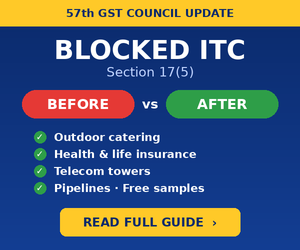
The 57th GST Council Meeting (8 October 2026) recommended amending Section 17(5) of the CGST Act, 2017 to allow Input Tax Credit (ITC) on outdoor catering, health and life insurance, telecom towers, pipelines laid outside factory premises, free samples, and goods destroyed or written off on expiry of shelf life as required by law. These are recommendations only. ITC remains blocked until the law is amended and notified.
Blocked credit under Section 17(5) has been one of the most disputed areas of GST. Genuine business expenses were denied credit, so tax got built into costs again, the very cascading effect GST was meant to remove. The 57th GST Council meeting has now recommended a major clean-up. This guide explains what was blocked before, what changes after, who benefits and what you should do now.
What Is Blocked ITC under Section 17(5)?
Blocked ITC means Input Tax Credit that a registered person cannot claim even when GST was charged on the purchase and the goods or services were used for business. Section 17(5) of the CGST Act lists these items, which include motor vehicles (with exceptions), food and beverages, outdoor catering, beauty treatment, membership of clubs, works contract and construction of immovable property, goods lost, stolen, destroyed or given as free samples, and others.
In simple words: you paid GST on the invoice, but the law did not let you set it off against your output GST liability. That tax became a business cost.
57th GST Council Meeting: Key Facts
- Date: 8 October 2026
- Focus: Process reforms in registration, refunds, ITC and litigation rather than rate changes
- Section affected: Section 17(5), CGST Act, 2017
- Objective: Reduce cascading of taxes and ensure smoother flow of ITC across the supply chain
- Legal status: Recommendations. They need a law amendment and notification to take effect.
Blocked ITC: Before vs After (Comparison Table)
| Category | Before (Existing) | After (Recommended) |
|---|---|---|
| Outdoor catering | ❌ ITC blocked (Section 17(5)(b)) | ✅ ITC allowed |
| Health and life insurance | ❌ ITC blocked (Section 17(5)(b)) | ✅ ITC allowed |
| Telecom towers | ❌ ITC blocked (Section 17(5)(d); treated as immovable property) | ✅ ITC allowed |
| Pipelines outside factory premises | ❌ ITC blocked (Section 17(5)(c) & (d)) | ✅ ITC allowed |
| Free samples | ❌ ITC blocked (Section 17(5)(h)) | ✅ ITC allowed |
| Goods destroyed / written off on expiry of shelf life | ❌ ITC blocked (Section 17(5)(h)) | ✅ ITC allowed (where destruction is required by law) |
Note: Clause references are indicative. Always verify against the current bare Act and the final amendment.
Category-wise Analysis
1. Outdoor Catering
Before: ITC on outdoor catering was blocked, except in limited cases, such as where the same line of business applies or where providing the service is mandatory under law. Many businesses, particularly those organizing conferences, staff meals and events, absorbed the GST as cost.
After: The Council recommended removing the restriction. Businesses that spend on catering for employees, trainings, dealer meets and events would be able to claim credit, subject to the usual conditions of Sections 16 and 17.
2. Health and Life Insurance
Before: ITC on health and life insurance was generally blocked unless the employer was legally obliged to provide it to employees.
After: The recommendation removes the restriction. Employers offering group health or life cover to employees could recover GST paid on premiums, which lowers the real cost of employee welfare.
3. Telecom Towers
Before: The department treated telecom towers as immovable property and denied ITC. The litigation went all the way to the Supreme Court in the Bharti Airtel case, which held towers to be movable in the relevant context.
After: The recommendation aligns the law with that Supreme Court ruling. Telecom operators and tower companies stand to gain, and an important area of litigation could settle.
4. Pipelines Laid Outside Factory Premises
Before: Pipelines outside the factory were treated as immovable property and excluded from “plant and machinery”, so ITC was blocked under Section 17(5)(c) and (d).
After: ITC would be allowed. This matters for oil and gas, chemicals, water and utility businesses that rely on long pipeline networks.
5. Free Samples
Before: Under Section 17(5)(h), ITC on goods disposed of as free samples was blocked, which penalized FMCG, pharma and consumer companies for a standard marketing practice.
After: ITC would be allowed, which brings the law in line with how products are actually promoted.
6. Goods Destroyed or Written Off on Expiry of Shelf Life
Before: Goods destroyed or written off were covered by Section 17(5)(h), so ITC was blocked even when destruction was mandatory (for example expired medicines or food products).
After: ITC would be allowed where the destruction or write-off of expired goods is required by law.
Who Benefits the Most?
- Telecom and tower companies: credit on tower infrastructure
- Oil, gas and infrastructure businesses: credit on pipelines
- FMCG, pharma and food companies: free samples and expired stock
- Employers and HR teams: insurance and catering costs
- Event, hospitality and corporate-training spenders: catering costs
Important: Can You Claim This ITC Right Now?
No. The Council only makes recommendations. Section 17(5) stands as it is until Parliament amends the CGST Act (and States amend their SGST Acts) and a commencement date is notified. Credit availed too early can be reversed with interest. Whether the changes apply prospectively or retrospectively is also not yet known.
What Should Businesses Do Now? (Action Checklist)
- Tag the spend: separate catering, insurance, tower, pipeline, sample and expiry-related costs in your books.
- Quantify, but do not book: estimate the possible ITC benefit for budgeting only.
- Watch for notification: track the amendment, commencement date and any transitional rules.
- Keep documents ready: tax invoices, proof of use for business, destruction certificates for expired goods.
- Review pricing and contracts: ITC recovery may change cost structures.
- Consult your GST professional before claiming any credit.
Frequently Asked Questions (FAQs)
What is blocked ITC under Section 17(5)?
Blocked ITC is input tax credit that cannot be claimed even though GST was paid on business purchases, because Section 17(5) of the CGST Act specifically excludes those items.
What did the 57th GST Council recommend on blocked ITC?
It recommended amending Section 17(5) to allow ITC on outdoor catering, health and life insurance, telecom towers, pipelines outside factory premises, free samples and goods destroyed or written off on expiry of shelf life as required by law.
When was the 57th GST Council meeting held?
On 8 October 2026.
Is ITC on outdoor catering allowed now?
Not generally. ITC remains restricted, subject to limited exceptions, until the law is amended and notified.
Will ITC on health and life insurance be available?
The Council has recommended it, but you can claim it only after the amendment takes effect.
Do the recommendations apply from today?
No. A legislative amendment and a notified effective date are required. Until then, the existing Section 17(5) applies.
Why are telecom towers and pipelines important in this change?
They were treated as immovable property, which led to long-running disputes. The recommendation aims to remove that uncertainty.
Conclusion
The 57th GST Council’s recommendations on Section 17(5) signal a shift towards a fairer, less litigious ITC regime. If notified as proposed, businesses could recover tax on expenses that were treated as costs earlier. Until then, prepare, track and wait for the official notification before claiming any credit.
Need help with GST compliance and ITC planning?
Talk to [YOUR BRAND / FIRM NAME] for a free ITC review.
Disclaimer: This article is for general information only and is not legal or tax advice. The changes discussed are recommendations of the 57th GST Council meeting and will take effect only on amendment and notification. Consult a qualified GST professional before acting. Last updated: 26 October 2026.
