57th GST Council Meeting 2026: Key Decisions & Big Changes
The 57th GST Council Meeting, held on 8 October 2026 at the Summit Room, Bharat Mandapam, New Delhi, delivered the biggest process-reform package since GST was launched in 2017. The meeting was chaired by Union Finance Minister Nirmala Sitharaman.
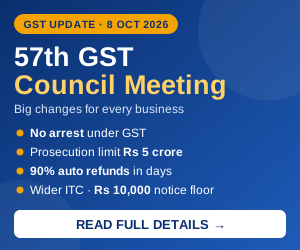
If the 56th meeting in September 2025 was about rates (GST 2.0 and the simplified slab structure), the 57th meeting was about process. The Council recommended scrapping arrest powers, raising the prosecution threshold to Rs 5 crore, automating refunds, unblocking input tax credit (ITC) on several expenses and simplifying registration and returns. There was no change to the headline GST rate slabs.
Who attended: Chief Ministers of Delhi, Goa, Haryana, Jammu & Kashmir, Karnataka, Kerala, Maharashtra and Meghalaya; Deputy Chief Ministers of Manipur and Telangana; Finance Ministers of States and UTs; the Revenue Secretary; and the Chairman and Members of CBIC.
Why the date moved: The meeting was first notified for 12 September 2026, shifted to 7 October because of the BRICS Leaders’ Summit in New Delhi, and finally moved to 8 October 2026 citing “unavoidable circumstances”. It was the Council’s first meeting in more than a year.
Table of Contents
- Key Highlights at a Glance
- Arrest Powers Removed, Prosecution & Penalties Eased
- Faster, Automated GST Refunds
- Wider Input Tax Credit (ITC)
- Simpler GST Registration
- Returns, Notices, Disputes & E-way Bills
- Exports, Small Taxpayers & Other Reforms
- GST Rate Changes & Clarifications
- Who Benefits & Implementation Timeline
- FAQs
Key Highlights of the 57th GST Council Meeting at a Glance
| Area | Before | After the 57th Council recommendation |
|---|---|---|
| Arrest powers (Sec 69) | Officers could arrest | Section 69 omitted — no arrest under GST |
| Prosecution threshold | Rs 1 crore | Rs 5 crore |
| Max general penalty (Sec 125) | Rs 25,000 | Rs 10,000 |
| Show cause notice floor | None | No SCN if tax involved is below Rs 10,000 |
| Non-fraud penalty if paid quickly | Higher | 5% if tax + interest paid within 30 days (Sec 73) / 60 days (Sec 74A) of the order |
| Refund acknowledgement | 15 days | 10 days; deemed acknowledgement after that |
| Provisional refund (exports, inverted duty) | Officer-processed | 90% auto-sanctioned by the system on risk basis |
| Cash ledger refund | Officer-processed | Fully automatic |
| Inverted duty refund on input services | Not allowed | Allowed for ITC availed on or after 1 Nov 2026 |
| Refund of ITC on capital goods | Not allowed | Allowed over 60 months for ITC availed on or after 1 Apr 2027 |
| Blocked credits (Sec 17(5)) | Catering, insurance, telecom towers etc. blocked | Several restrictions removed |
| Pre-deposit cap (penalty-only appeals) | No cap | Rs 40 crore (Rs 20 cr CGST + Rs 20 cr SGST) |
| Late fee (turnover up to Rs 5 crore) | Applied | Waived if return filed by end of the due month |
| E-way bill interception | Any officer, any State | Only on intelligence, Joint Commissioner approval, no transit-State checks |
| Headline GST rate slabs | — | No change |
Big Change 1: GST Arrest Powers Removed, Prosecution and Penalties Eased
The headline decision: the Council recommended complete withdrawal of arrest powers under GST by omitting section 69 of the CGST Act, 2017. This moves GST to a trust-based enforcement model while keeping deterrence against genuine fraud.
- Prosecution threshold raised from Rs 1 crore to Rs 5 crore.
- Section 132 narrowed: clause (i) of section 132(1) omitted; the words “evades tax” removed from clause (e); “or in any other manner deals with” removed from clause (h).
- Fake ITC focus: clause (c) of section 132(1) will cover only fraudulent ITC availed without receipt of goods/services or without an invoice.
- Punishments rationalised for various offences under section 132.
- General penalty cut under section 125 from Rs 25,000 to Rs 10,000.
- Minimum penalty of Rs 10,000 removed in non-fraud cases.
- Penalty treated as “charge” where full tax, interest and penalty are paid voluntarily within the time limit.
Big Change 2: Faster, Automated GST Refunds
Refunds for excess cash ledger balance, zero-rated supplies (exports/SEZ) and inverted duty structure move to system-based processing in two phases, through amendments to section 54 and the CGST Rules.
Phase 1
- Excess cash ledger balance: full refund sanctioned automatically, with no officer intervention.
- Acknowledgement or deficiency memo within 10 days (down from 15); if the officer misses it, the system deems it acknowledged.
- Exports and inverted duty claims: 90% sanctioned provisionally and automatically on the basis of system risk evaluation.
Phase 2
- System-based automated acknowledgement after verification of the application.
- Full automated sanction of zero-rated supply refunds after adjusting pending dues, on a risk basis.
Other refund fixes
- FORM GST RFD-01 becomes system-readable; no scanned documents for export and inverted duty claims.
- Rule 89(4)(C) cap removed — export turnover no longer limited to 1.5 times the value of like goods supplied domestically.
- The Rs 1,000 minimum refund threshold under section 54(14) applies to the combined CGST + SGST/UTGST + IGST amount.
- Section 115 to become a standalone provision on interest for refund of appeal pre-deposits, backed by a clarifying circular.
Big Change 3: Wider Input Tax Credit (ITC)
Blocked credits under section 17(5) relaxed. ITC restrictions are to be removed on, among others:
- Outdoor catering
- Health and life insurance
- Telecommunication towers
- Pipelines laid outside factory premises
- Free samples
- Goods destroyed or written off on expiry of shelf life as required by law
This is a major relief for FMCG and pharma companies, which routinely distribute free samples and write off expired stock.
Refund of accumulated ITC on capital goods and input services (amendment to section 54(3)):
- Inverted duty refunds will include ITC on input services availed on or after 1 November 2026.
- Export and inverted duty refunds will include ITC on capital goods, spread over 60 months, for ITC availed on or after 1 April 2027.
Limited ITC in the same line of business is now allowed for restaurant/outdoor catering, hotel accommodation up to Rs 7,500 per unit per day, and gym/fitness services — matching the treatment already given to passenger transport, tour operators and motor vehicle rental.
Rule 86A safeguard: taxpayers can object to blocking of their electronic credit ledger and get a personal hearing before a decision.
Big Change 4: Simpler GST Registration
- Clear document checklist: a comprehensive circular and FAQs listing documents for registration; FORM GST REG-01 gets drop-down boxes for prescribed documents; a friendlier portal with tool-tips and guided navigation.
- Automatic amendments: under rule 19, changes to all registration particulars except Principal Place of Business (PPoB) will be auto-accepted. For taxpayers on the automatic route (rule 14A), even PPoB changes are auto-accepted.
- Automatic cancellation — Phase 1: REG-16 applications auto-accepted once returns are filed and dues paid, if the taxpayer never passed on ITC above Rs 2.5 lakh in a month, or did and has filed GSTR-10 on time.
- Automatic cancellation — Phase 2: all cancellation applications auto-accepted once returns and dues are clear; GSTR-10 details captured inside REG-16 itself.
- System-based suo-moto cancellation and revocation for non-filing of returns or missing bank details (rules 21A, 22 and new rule 23A); some officer grounds for cancellation under rule 21 omitted.
Big Change 5: Returns, Notices, Disputes and E-way Bills
Returns — fewer mismatches (from the April 2027 return)
- GSTR-1/1A/IFF enhanced for better reconciliation with GSTR-3B.
- New rule 86D: “Electronic Statement of tax paid on Reverse charge basis and ITC claimed”.
- New rule 86C: “Electronic Credit Reversal and Reclaim Statement”.
- Rule 61(1A) and 61(1B): mechanisms to correct liability (GSTR-3B vs GSTR-1) and ITC (GSTR-3B vs GSTR-2B).
- Rule 60(6A): IMS lets recipients accept, reject or keep pending inward documents, with limits on how long credit notes can stay pending.
- DRC-03 will capture the underlying invoice for each payment.
- The revised mechanism will go to public consultation first.
Notices and adjudication
- No show cause notice if tax involved is below Rs 10,000 (CGST + SGST + IGST + Cess); pending small notices and appeals will be decided as if this floor already applied.
- A circular on the quality and timeliness of notices and orders, invoking fraud/suppression only on merits, and personal hearings.
- Validation clause for notices courts struck down for covering multiple financial years.
E-way bill (sections 68, 129, 130)
- Vehicles intercepted only on specific intelligence, with approval of an officer not below Joint Commissioner.
- Action only in the State where the supplier or recipient is located or registered — no interception in transit States.
- Goods with no e-way bill or no origin/destination document can still be checked anywhere.
- No confiscation under section 130 for goods or vehicles in transit.
Big Change 6: Exports, Small Taxpayers and Other Reforms
Export of services and goods
- Section 2(6)(v) of the IGST Act omitted — services to your own foreign branch/office can now qualify as export.
- Section 13(3)(a) of the IGST Act omitted — place of supply for services on goods made available by a foreign recipient follows the recipient’s location, opening export benefits.
- Goods sold to an overseas buyer but delivered in an SEZ/FTWZ, paid in foreign exchange (or INR where RBI permits), are deemed supplies to SEZ/FTWZ — zero-rated.
- A circular on receiving export payment in foreign exchange or Indian rupees.
Small taxpayers
- Late fee waived for taxpayers with turnover up to Rs 5 crore if the return is filed by the end of the month in which it was due.
- ARQP scheme (in-principle): an optional Annual Return Quarterly Payment scheme for businesses with turnover up to Rs 5 crore making only B2C supplies.
Other changes
- Pre-deposit for penalty-only appeals capped at Rs 40 crore (Rs 20 crore CGST + Rs 20 crore SGST/UTGST).
- Transfer of title in IPRs, temporary or permanent, uniformly treated as a supply of services.
- Time limits for GSTR-1/GSTR-3B aligned with the ITC time limit under section 16(4).
- ECO liability under section 9(5) clarified regardless of business model.
- E-invoicing extended to RCM purchases from unregistered persons and import of services for taxpayers with turnover of Rs 5 crore and above.
- Circulars on ISD, ITC for banks/NBFCs under section 17(4), pre-deposits and demo vehicles; rule 96(10) omitted from 23 October 2017 in line with the Supreme Court ruling.
- GSTAT provisions aligned with the Tribunals Reforms Act, 2026.
GST Rate Changes and Clarifications
No headline slab changed, but several items and services got targeted changes.
Goods
| Item | Decision |
|---|---|
| Waste & scrap (plastic, e-waste, tyres), used cooking oil | RCM when supplied by unregistered to registered person; 2% TDS on B2B supplies |
| Psyllium (Isabgol) seeds | NIL GST, whether fresh, chilled, frozen or dried |
| Re-treaded tractor tyres | Rate aligned with new tractor tyres |
| Toys (heading 9503) | Concessional entry covers dolls, puzzles and all toys, not only tricycles/scooters |
| Sublimation paper | Classified under heading 4809; past cases regularised |
| Seaweed-extract bio-stimulants | Classified as fertilisers (heading 3101); past cases regularised |
| Second-hand vehicles (margin scheme) | ITC allowed on spares, repairs, rent, marketing etc.; bar only on the vehicles bought |
| CSD / Unit Run Canteens | Compensation cess not levied in past periods exempted |
Services
| Service | Decision |
|---|---|
| EV passenger transport / rental with operator | Optional 5% with restricted ITC, where charging cost is included |
| Delivery services via e-commerce operators | 5% without ITC; GTA exemption removed for ECO-ordered goods to unregistered persons |
| Helicopter seat-sharing (North-East, Sikkim, Bagdogra) | Exempt |
| Storage/warehousing of seeds for sowing | Exempt |
| Curing of coffee | Exempt |
| Seamen’s Provident Fund Organisation | Exempt |
| NHAI TOT toll concession (upfront amount) | Exempt |
| R&D services | Self-certification by head of institution for exemption |
| Foreign shipping lines’ Indian establishments | Import of services from related persons without consideration exempt; past regularised |
| Bank Fund Transfer Pricing | Notional interest treated as “interest” |
| Motor vehicle leasing | Clarity on recovery of road tax, registration, insurance, FASTag |
Who Benefits from the 57th GST Council Decisions
| Stakeholder | Main gain |
|---|---|
| MSMEs and small traders | No arrest, Rs 10,000 notice floor, late-fee waiver, ARQP option, auto registration changes |
| Exporters | 90% auto provisional refund, no 1.5x cap, branch services as exports, capital goods ITC refund |
| FMCG and pharma | ITC on free samples and expired goods written off |
| E-commerce sellers | Register in other States using the ECO warehouse as PPoB |
| Transporters | No transit-State interception, no confiscation in transit |
| Hotels, restaurants, gyms | Limited ITC in the same line of business |
Implementation timeline
- 1 November 2026: inverted duty refund on input services (for ITC availed from this date).
- April 2027 return: new return-correction and reconciliation mechanism.
- 1 April 2027: capital goods ITC refund over 60 months (for ITC availed from this date).
- Law amendments: arrest, prosecution, penalty and section 17(5) changes need amendments to the CGST/IGST Acts, typically through the Finance Bill. Rate and procedure changes come via notifications and circulars.
Frequently Asked Questions (FAQs)
When was the 57th GST Council Meeting held?
On 8 October 2026 at Bharat Mandapam, New Delhi, chaired by Finance Minister Nirmala Sitharaman.
Did GST rates change in the 57th GST Council Meeting?
The headline slabs did not change. Specific items such as Isabgol seeds (NIL), EV passenger transport (optional 5%) and ECO delivery services (5%) were addressed.
Can GST officers still arrest taxpayers?
The Council recommended omitting section 69 of the CGST Act, removing arrest powers entirely. It applies once the Act is amended.
What is the new GST prosecution threshold?
Rs 5 crore, up from Rs 1 crore.
Will small GST notices still be issued?
No show cause notice will be issued where the tax involved is below Rs 10,000.
How fast will GST refunds be now?
Acknowledgement within 10 days, and 90% provisional refund auto-sanctioned for exports and inverted duty claims on a risk basis.
What is the ARQP scheme?
An optional Annual Return Quarterly Payment scheme for B2C-only businesses with turnover up to Rs 5 crore, approved in principle by the Council.
Conclusion
The 57th GST Council Meeting turns GST 2.0 from a rate reform into a full compliance reform. Removing arrest powers, automating refunds and unblocking ITC should cut litigation and free up working capital, especially for MSMEs and exporters. Businesses should watch for the notifications, circulars and Finance Bill amendments that will bring each change into force.
Source: Ministry of Finance (PIB) release on the recommendations of the 57th GST Council Meeting, 8 October 2026.
