FAST-DS 2026: Foreign Assets of Small Taxpayers – Disclosure Scheme (Complete Guide)
By [Devendra Singhal] • Updated: 2 November 2026 • Reading time: about 12 minutes
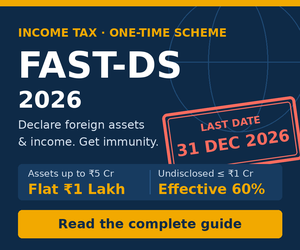
Quick answer: FAST-DS 2026 is a one-time, voluntary Income Tax disclosure scheme under Chapter IV (Sections 130–144) of the Finance Act, 2026. It lets eligible small taxpayers declare undisclosed foreign assets or foreign income of up to ₹1 crore by paying 30% tax plus an equal additional amount (an effective 60%), or declare foreign assets of up to ₹5 crore that were not reported in Schedule FA by paying a flat fee of ₹1 lakh. The scheme came into force on 16 August 2026 and declarations in Form 1 must be filed online on or before 31 December 2026. Assets are valued as on 31 March 2026.
Deadline alert: The last date to file Form 1 is 31 December 2026. No declaration can be filed after this date. Gathering bank statements, valuation reports and acquisition proofs takes time, so start early.
In this guide
- What is FAST-DS 2026?
- Why the government introduced it
- Key dates and facts at a glance
- Who is eligible?
- The two categories of declaration
- How much do you have to pay?
- How to value foreign assets
- How to file Form 1 (step by step)
- Forms 1, 2, 3 and 4 explained
- Benefits and immunity
- Who cannot use the scheme?
- Who should consider it?
- Common mistakes to avoid
- Document checklist
- Frequently asked questions
What is FAST-DS 2026?
FAST-DS stands for the Foreign Assets of Small Taxpayers – Disclosure Scheme, 2026. It is a time-bound compliance window contained in Chapter IV (Sections 130 to 144) of the Finance Act, 2026, and it operates alongside the Foreign Assets of Small Taxpayers – Disclosure Scheme Rules, 2026, which were notified by the Central Board of Direct Taxes (CBDT) on 14 August 2026.
In simple words, if you are an Indian taxpayer who owns an overseas bank account, shares, ESOPs/RSUs, property or income that you forgot, or did not know how, to report in your Indian Income Tax Return (ITR), this scheme gives you a one-time chance to come clean, pay a defined amount and obtain protection from further tax, penalty and prosecution under the Black Money (Undisclosed Foreign Income and Assets) and Imposition of Tax Act, 2015 (the “Black Money Act”).
Why did the government introduce FAST-DS?
The scheme was announced by Finance Minister Nirmala Sitharaman in the Union Budget 2026–27 on 1 February 2026. Under normal rules, a resident taxpayer must report every foreign asset in Schedule FA of the ITR. Missing it can attract a heavy penalty and, in serious cases, prosecution under the Black Money Act, even where the amount involved is small and there was no intention to hide wealth.
Many such cases involve returning NRIs, professionals who worked abroad, employees of multinational companies holding foreign stock, and students or families with small legacy bank balances overseas. FAST-DS is designed to resolve these legacy cases of small taxpayers through a simple, proportionate and fully online process.
Key dates and facts at a glance
| Particular | Details |
|---|---|
| Scheme name | Foreign Assets of Small Taxpayers – Disclosure Scheme, 2026 (FAST-DS 2026) |
| Legal basis | Chapter IV, Sections 130–144, Finance Act, 2026, read with FAST-DS Rules, 2026 |
| Announced | Union Budget 2026–27 (1 February 2026) |
| Rules notified | 14 August 2026 |
| Scheme in force from | 16 August 2026 |
| Last date to file declaration | 31 December 2026 |
| Valuation date | 31 March 2026 |
| Mode of filing | Online only, on the Income Tax e-Filing portal (Form 1) |
| Administering authority | Principal Director General / Director General of Income-tax (Systems) |
| Law under which immunity is given | Black Money Act, 2015 |
Who is eligible to make a declaration?
An “assessee” can use FAST-DS if either of the following is true:
- Resident in India (as per Section 6 of the Income-tax Act, 1961) in the relevant previous year; or
- Non-resident or Resident but Not Ordinarily Resident (RNOR) in the relevant year, but who was a resident either (a) in the year to which the undisclosed foreign income relates, or (b) in the year in which the undisclosed foreign asset was acquired.
So a person who has since moved abroad can still file, provided the residency condition for the relevant year is met. Returning NRIs, former residents and RNORs are therefore covered, subject to the conditions.
On what grounds can a declaration be made?
A declaration can be made where the taxpayer:
- failed to furnish a return under Section 139 of the Income-tax Act, 1961; or
- failed to disclose the asset or income in a return filed before the scheme began; or
- has income or an asset that has escaped assessment within the meaning of Section 147.
A declaration can relate to any previous year, subject to the value limits below.
The two categories of declaration
FAST-DS has two broad categories. Choosing the correct one is the most important decision you will make, because the cost is very different.
Category 1: Undisclosed foreign asset or undisclosed foreign income
This covers:
- An undisclosed asset located outside India, including a financial interest in any entity, held in your own name or where you are the beneficial owner, where you have no explanation of the source of investment or the explanation is unsatisfactory to the Assessing Officer.
- Undisclosed foreign income, meaning income from a source outside India that was chargeable to tax in India but was not offered to tax.
Limit: the aggregate value of the undisclosed asset (as on 31 March 2026) and the undisclosed foreign income must not exceed ₹1 crore.
Category 2: Foreign asset already taxed, or acquired as a non-resident, but not reported in Schedule FA
This covers a foreign asset that was already offered to tax (that is, bought out of taxed income) or was acquired while you were a non-resident, but was not declared in the relevant schedule of your return.
Limit: the aggregate value of such foreign assets must not exceed ₹5 crore. If the value is above ₹5 crore, the scheme is not available.
How much do you have to pay?
| Feature | Category 1 (undisclosed asset / income) | Category 2 (taxed or non-resident-acquired asset, not in Schedule FA) |
|---|---|---|
| Value limit | Up to ₹1 crore (asset + income combined) | Up to ₹5 crore |
| Amount payable | 30% tax plus an additional amount equal to the tax (effective 60%) | Flat fee of ₹1 lakh |
| Valuation date | 31 March 2026 | 31 March 2026 |
Worked example (Category 1)
Suppose you have an undisclosed foreign bank account valued at ₹60 lakh and undisclosed foreign income of ₹20 lakh. The total of ₹80 lakh is within the ₹1 crore limit.
| Item | Value / income | Tax @ 30% | Additional (equal to tax) | Total payable |
|---|---|---|---|---|
| Foreign bank account | ₹60 lakh | ₹18 lakh | ₹18 lakh | ₹36 lakh |
| Foreign income | ₹20 lakh | ₹6 lakh | ₹6 lakh | ₹12 lakh |
| Total | ₹80 lakh | ₹24 lakh | ₹24 lakh | ₹48 lakh |
Why this can still be a good deal: Under the Black Money Act, undisclosed foreign assets are ordinarily taxed at 30%, with a separate penalty that can go up to 90% of the tax, and a penalty of up to ₹10 lakh for not reporting a foreign asset in the return, apart from the risk of prosecution. FAST-DS replaces that exposure with a known, capped payment. Always compare the numbers for your own case with a qualified professional.
Payment timeline
- The tax authority issues an order in Form 2 stating the amount payable, within one month from the end of the month in which you filed the declaration.
- You must pay within two months from the end of the month in which the Form 2 order is received.
- If you miss it, you get a further period of up to two months, with simple interest at 1% for every month or part of a month of delay.
- The outer limit is four months from the end of the month in which Form 2 was passed. After that, the benefit of the scheme is lost for that declaration.
How to value foreign assets under FAST-DS
Values must be reported in Indian Rupees, as on 31 March 2026. As a general rule, fair market value (FMV) is the higher of (a) the cost of acquisition and (b) the price the asset would ordinarily fetch in the open market on the valuation date. Where a market valuation is not carried out, the indexed cost of acquisition is treated as the FMV.
| Asset | How FMV is determined |
|---|---|
| Foreign bank account | The sum of all deposits made into the account from the date it was opened up to 31 March 2026. Deposits made out of withdrawals from the same account are excluded to avoid double counting. If part of the account was earlier declared under Chapter VI of the Black Money Act, only deposits since that declaration are counted. |
| Quoted shares and securities | Higher of cost of acquisition and the average of the lowest and highest price on an established securities market on the valuation date. If there was no trading that day, the nearest preceding trading day is used. |
| Unquoted equity shares | Higher of cost of acquisition and the value arrived at by the prescribed formula. |
| Other unquoted shares / securities | Higher of cost and open-market price, supported by a recognised valuer’s report. |
| Immovable property abroad | Higher of cost and open-market price, supported by a valuation report from a valuer recognised in the country where the property is located. |
| Bullion, jewellery, precious stones, art | Higher of cost and open-market price, supported by a recognised valuer’s report. |
| Interest in a foreign partnership, AOP or LLP | Based on net assets as on the valuation date, allocated first by capital contribution and then as per the agreement or profit-sharing ratio. |
| Any other (residuary) asset | Higher of cost/amount invested and arm’s-length open-market price. |
Currency conversion
If the currency is one designated by the RBI under the Foreign Exchange Management (Deposit) Regulations, 2016, convert at the RBI reference rate on 31 March 2026. Otherwise, first convert to US dollars at the rate of the central bank (or another regulated bank) of the country where the asset is located, then convert to rupees at the RBI reference rate.
Avoiding double counting
If sale proceeds of one asset, or a withdrawal from a bank account, were used to buy another asset, the FMV of the old asset or account is reduced by the amount reinvested, and the new asset is valued separately.
20% tolerance on valuation
For assets other than a bank account, if the value later determined by the Assessing Officer differs from your declared value by no more than 20%, the declaration will not be treated as void merely on grounds of misrepresentation, suppression of facts or false particulars.
How to file Form 1 on the Income Tax portal (step by step)
- Review your records. Check old ITRs and Schedule FA entries, overseas bank statements, brokerage and ESOP/RSU statements, property papers and employment history.
- Fix your residential status for the relevant years and confirm you meet the eligibility conditions.
- Pick the category (Category 1 or Category 2) and confirm the value is within ₹1 crore or ₹5 crore.
- Value each asset as on 31 March 2026 using the prescribed rules and, where needed, a valuer’s report.
- Log in to the e-Filing portal at www.incometax.gov.in.
- Go to e-File → Income Tax Forms → File Income Tax Forms → Forms as per other Acts, and select Foreign Assets of Small Taxpayers Disclosure Scheme, 2026 (Form 1).
- Fill in Form 1, repeating entries for each asset or income item, upload supporting documents and valuation reports, and submit with electronic verification.
- Wait for Form 2, then pay the amount (through e-Pay Tax, challan ITNS 289) within the allowed time.
- File Form 3 (intimation of payment with proof) and receive the certificate in Form 4.
Forms 1, 2, 3 and 4 explained
| Form | Who files / issues | Purpose |
|---|---|---|
| Form 1 | Taxpayer | Electronic declaration of the asset or income, with documents and valuation reports |
| Form 2 | Tax authority | Order stating the amount payable, issued within one month from the end of the month of declaration |
| Form 3 | Taxpayer | Intimation of payment (with proof, including interest if any) within the permitted period |
| Form 4 | Tax authority | Certificate confirming payment, issued within one month from the end of the month in which Form 3 is received |
Benefits and immunity on a valid declaration
- Immunity from further tax and penalty under the Black Money Act, 2015 in respect of the declared income or asset.
- Immunity from prosecution under the Black Money Act for the declared income or asset.
- The declared income or the investment in the declared asset is not included in your total income under the Income-tax Act, 1961 or the Black Money Act.
- If assessment proceedings are already pending for the declared item, the Assessing Officer must take the declaration into account while finalising the assessment.
- A fully online, faceless process with defined timelines.
What you cannot do after declaring
For the income or asset declared, or any amount paid, you cannot seek rectification or revision of an earlier assessment, or claim set-off or relief in any related appeal or proceeding.
Who cannot use FAST-DS 2026?
The scheme does not apply to:
- any income or asset that directly or indirectly represents proceeds of crime where proceedings have been initiated or are pending under the Prevention of Money-laundering Act, 2002; and
- any income or asset relating to an assessment year for which assessment proceedings have already been completed under the Black Money Act, 2015.
It also cannot be used where the aggregate value is above ₹1 crore (Category 1) or ₹5 crore (Category 2).
Who should seriously consider FAST-DS?
- Returning NRIs who kept a foreign bank account or investments after becoming resident again.
- Employees with foreign ESOPs or RSUs of a multinational parent company that were never shown in Schedule FA.
- Professionals who worked abroad and have dormant overseas savings, retirement or brokerage accounts.
- Parents or relatives who are beneficial owners of accounts opened for children studying abroad.
- Taxpayers who received advisory emails or SMS from the Income Tax Department about foreign assets and have not yet reviewed their returns.
Common mistakes to avoid
- Choosing the wrong category. An asset bought out of taxed income belongs in Category 2 (₹1 lakh fee), not Category 1 (effective 60%).
- Using the wrong value. Use 31 March 2026 values and RBI reference rates, not today’s balance or exchange rate.
- Ignoring the bank-account rule. A bank account is valued by total deposits since opening, not just the closing balance.
- Missing documents. Form 1 requires proof of acquisition or earning and valuation reports where applicable.
- Leaving it to the last week. Foreign bank statements and valuer reports take weeks to arrange.
- Missing the payment windows. The benefit lapses if payment is not made within the outer four-month limit.
- Forgetting future compliance. FAST-DS clears the past. From now on, report every foreign asset in Schedule FA of your ITR.
Document checklist
- PAN, Aadhaar and e-Filing portal login
- Past ITRs and Schedule FA, where filed
- Passport and proof of residential status for each relevant year
- Foreign bank statements from the date of opening up to 31 March 2026
- Brokerage, ESOP/RSU, vesting and sale statements
- Property purchase deeds and local valuation reports
- Evidence of source of funds (salary slips, tax returns of the foreign country, Form 16 equivalents)
- RBI reference rate for 31 March 2026 for conversion
Frequently asked questions (FAQs)
What is FAST-DS 2026?
It is a one-time voluntary disclosure scheme under Sections 130–144 of the Finance Act, 2026 that allows eligible small taxpayers to declare certain undisclosed foreign assets or foreign income, or foreign assets not reported in Schedule FA, by paying a specified tax or fee.
What is the last date for FAST-DS 2026?
The last date to file Form 1 is 31 December 2026. The scheme came into force on 16 August 2026, and no declaration can be filed after the last date.
How much tax is payable under FAST-DS?
For undisclosed foreign assets or income up to ₹1 crore, you pay 30% tax plus an additional amount equal to the tax, which is an effective 60%. For foreign assets up to ₹5 crore that were taxed already or acquired as a non-resident but not reported in Schedule FA, the fee is a flat ₹1 lakh.
Can an NRI or a returning NRI use FAST-DS?
Yes, if the person was a resident in India in the year to which the foreign income relates, or in the year the foreign asset was acquired. Non-residents and RNORs who meet this residency condition can file.
What is the valuation date under FAST-DS?
31 March 2026. Foreign currency values are converted into rupees at the RBI reference rate on that date.
Where do I file Form 1?
On the Income Tax e-Filing portal: e-File → Income Tax Forms → File Income Tax Forms → Forms as per other Acts → Foreign Assets of Small Taxpayers Disclosure Scheme, 2026 (Form 1).
What immunity do I get after a valid declaration?
You get immunity from further tax, penalty and prosecution under the Black Money Act, 2015 for the declared income or asset, and the declared amount is not included in your total income under the Income-tax Act or the Black Money Act.
How is a foreign bank account valued?
By adding all deposits made into the account from the date of opening to 31 March 2026, excluding deposits made out of withdrawals from the same account and, where applicable, amounts already declared and taxed under Chapter VI of the Black Money Act.
What if I cannot pay within two months of the Form 2 order?
You can pay within a further period of up to two months with simple interest at 1% per month or part of a month. Beyond four months from the end of the month in which Form 2 was passed, the scheme benefit is lost.
Does FAST-DS apply if the assessment is already completed under the Black Money Act?
No. The scheme does not apply to income or assets for an assessment year in which assessment proceedings under the Black Money Act have already been completed, nor to proceeds of crime under PMLA proceedings.
Conclusion
FAST-DS 2026 is a practical, one-time opportunity to close old foreign-asset reporting gaps at a defined cost and with statutory immunity. With the last date set at 31 December 2026, the sensible approach is to identify every overseas account, investment and income source now, choose the correct category, value assets as on 31 March 2026 and file Form 1 well before the final week. After you are done, make Schedule FA reporting part of every future return.
Get expert help with your FAST-DS filing
Disclaimer: This article is for general information only and is not tax, legal or financial advice. [www.eserviceshelp.in] is an independent publisher and is not affiliated with the Income Tax Department or the Government of India. Tax laws, rules, forms and due dates can change. Please verify details on the official Income Tax portal (incometax.gov.in) and consult a Chartered Accountant or tax professional before filing. Sources used: Finance Act 2026 Chapter IV, FAST-DS Rules 2026, Income Tax Department FAQs and press coverage of the CBDT notification.
