E-Invoice for RCM Self-Invoice from 1 Jan 2027: GSTN Advisory
Quick answer: From 1 January 2027, e-invoicing becomes mandatory for RCM self-invoices — both domestic purchases from unregistered suppliers (RCMDOM) and import of services (RCMIMP). The GSTN advisory dated 17 November 2026 allows voluntary IRN generation from 15 December 2026.
Key Takeaways
- Mandatory date: 1 January 2027.
- Voluntary window: 15–31 December 2026 (IRN generation for genuine transactions).
- Covers: RCM self-invoices for supplies from unregistered persons (RCMDOM) and import of services (RCMIMP).
- Legal basis: Notification Nos. 04/2026-Central Tax and 05/2026-Central Tax (both dated 26 October 2026).
- Action: update and test your billing/ERP software now.
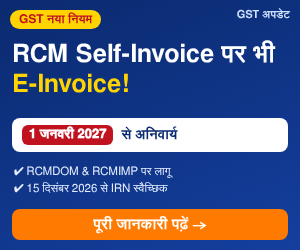
What has changed in GST e-invoicing?
Until now, e-invoicing covered invoices that a supplier raises. The new rule extends it to invoices a buyer raises for themselves — the self-invoices created when tax is payable under the Reverse Charge Mechanism (RCM). The recipient generates the self-invoice and submits its details to an Invoice Registration Portal (IRP) to receive an Invoice Reference Number (IRN) and QR code.
GSTN first introduced the two new categories in an advisory of 16 October 2026 and confirmed the rollout dates in its advisory of 17 November 2026.
Important dates at a glance
| Date | What happens |
|---|---|
| 26 Oct 2026 | Notification Nos. 04/2026 & 05/2026-Central Tax issued. |
| 17 Nov 2026 | GSTN advisory on implementation for RCMDOM and RCMIMP. |
| 15 Dec 2026 | Voluntary IRN generation begins; production accepts documents dated 15 Dec 2026 or later. |
| 15–31 Dec 2026 | Voluntary adoption period. |
| 1 Jan 2027 | E-invoicing mandatory for RCM self-invoices. |
Which transactions are covered?
- RCMDOM – domestic purchases from an unregistered supplier where GST is payable under reverse charge.
- RCMIMP – import of services where GST is payable under reverse charge.
Who should pay attention?
- GST-registered businesses that buy under RCM.
- Businesses that buy from unregistered suppliers and pay RCM.
- Businesses receiving services from outside India.
- GST practitioners, CAs, ERP/GSP/ASP providers and accounting teams.
Note: E-invoicing applies only to taxpayers already covered by the e-invoicing turnover threshold (currently ₹5 crore aggregate turnover per published summaries). Please confirm your own applicability on the official GST e-invoice portal.
How to prepare: 6-step checklist
- Identify all RCM purchases (unregistered suppliers and import of services).
- Ask your billing/ERP vendor whether RCMDOM and RCMIMP supply types are supported.
- Test using the sandbox, which GSTN says is live on all six IRPs.
- Use 15–31 December 2026 for genuine-transaction trials only.
- Review your self-invoice numbering series to avoid duplicate-IRN rejections.
- Train accounts staff and set a monthly reconciliation with GSTR-3B.
Frequently Asked Questions (FAQs)
Q1. From when is e-invoicing mandatory for RCM self-invoices?
From 1 January 2027.
Q2. Can I generate an IRN before 1 January 2027?
Yes. Voluntary generation is possible from 15 December to 31 December 2026, and sandbox testing is already available.
Q3. What are RCMDOM and RCMIMP?
RCMDOM is the supply type for domestic purchases from unregistered suppliers under RCM; RCMIMP is for import of services under RCM.
Q4. Which notifications support this change?
Notification No. 04/2026-Central Tax and No. 05/2026-Central Tax, both dated 26 October 2026.
Q5. Do I need to update my billing software?
Yes. Your software must generate the self-invoice in the e-invoice schema and obtain an IRN from an IRP.
हिंदी सारांश (Hindi Summary)
GSTN की नई एडवाइज़री के अनुसार 1 जनवरी 2027 से RCM के तहत बनने वाले self-invoice (RCMDOM और RCMIMP) पर भी E-Invoice अनिवार्य होगा। 15 दिसंबर 2026 से स्वेच्छा से IRN जनरेट किया जा सकेगा। सभी कारोबारी और GST practitioners अपना billing software समय रहते अपडेट करवा लें।
Sources: GSTN advisory dated 17 November 2026; Notification Nos. 04/2026-Central Tax and 05/2026-Central Tax (26 October 2026). Disclaimer: This article is for general information only and is not legal or tax advice. Please consult a qualified GST professional and verify on the official GST portal.
