GOODS AND SERVICES TAX
Important Limits of GST
GST में ये Important Limits जानना बहुत जरूरी है
Updated November 2026 • Quick-reference guide for businesses, traders & professionals
Missing a single GST limit can cost a business its input tax credit, a penalty, a blocked e-way bill or even its registration. Registration, composition, e-invoicing, e-way bills, ITC deadlines, annual returns and TDS all depend on specific turnover or value thresholds, and they are easy to confuse. This guide puts all 15 important GST limits in one place, explains what each one means in plain language, and shows how to stay compliant.
Quick Answer (30-second summary)
GST registration is mandatory above
₹40 lakh (goods) / ₹20 lakh (services). E-invoicing applies above
₹5 crore. An e-way bill is needed above
₹50,000. ITC must be claimed by
30 November of the next financial year (or annual return date, if earlier). GSTR-9C is required above
₹5 crore. Rule 86B requires
1% cash payment when monthly taxable turnover exceeds
₹50 lakh.
Deadline alert: 30 November 2026
If you have not yet claimed ITC on invoices and debit notes pertaining to FY 2025-26, the cut-off is 30 November 2026 (or the date you file your GSTR-9, if earlier). Reconcile GSTR-2B with your books now.
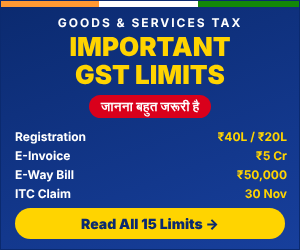
GST Limits at a Glance (Table)
| Provision |
Limit / Threshold |
Applies To |
| 1. GST Registration |
₹40 Lakh (Goods) / ₹20 Lakh (Services) |
Aggregate turnover in a financial year |
| 2. Composition Scheme |
₹1.5 Crore |
Goods suppliers, manufacturers, restaurants |
| 3. Composition (Services) |
₹50 Lakh |
Service providers / mixed suppliers |
| 4. E-Invoice |
Above ₹5 Crore turnover |
B2B, export and SEZ invoices |
| 5. E-Way Bill |
Consignment value above ₹50,000 |
Movement of goods |
| 6. HSN Code |
4 digits up to ₹5 Cr / 6 digits above ₹5 Cr |
Tax invoices |
| 7. ITC Claim |
30 November (next FY) |
Or annual return date, whichever is earlier |
| 8. QRMP Scheme |
Up to ₹5 Crore |
Quarterly returns, monthly payment |
| 9. Rule 86B |
1% cash payment above ₹50 Lakh monthly turnover |
Restriction on using ITC |
| 10. GST Refund |
2 Years |
From the relevant date |
| 11. Revocation of Cancellation |
90 Days |
Extendable with officer approval |
| 12. Rule 14A |
B2B tax liability up to ₹2.5 Lakh (per month) |
Simplified registration |
| 13. GSTR-9 |
Optional up to ₹2 Crore |
Annual return |
| 14. GSTR-9C |
Above ₹5 Crore |
Reconciliation statement |
| 15. TDS under GST |
Contract value above ₹2.5 Lakh |
Specified government deductors |
Note: limits shown are the general limits for most states. Special category states, specific sectors and notified exceptions may differ. Always check the latest notifications on the GST portal.
A. Registration and Scheme Limits
1. GST Registration Limit
Limit: ₹40 Lakh (Goods) / ₹20 Lakh (Services)
A person supplying goods must register under GST once aggregate turnover in a financial year crosses ₹40 lakh. A pure service provider must register once turnover crosses ₹20 lakh. Certain special category states have lower limits (₹20 lakh for goods and ₹10 lakh for services).
- Registration is compulsory regardless of turnover for inter-state supply of goods, e-commerce sellers, casual taxable persons, reverse-charge cases and some other categories.
- Turnover includes taxable, exempt, exports and inter-state supplies, but excludes tax itself.
- Track turnover monthly so you can apply within 30 days of crossing the limit.
2. Composition Scheme
Limit: ₹1.5 Crore
Small manufacturers, traders and restaurants with turnover up to ₹1.5 crore can opt for the composition scheme and pay tax at a low fixed rate on turnover (1% for manufacturers and traders, 5% for restaurants). The limit is lower in some special category states.
- Benefits: simple compliance, quarterly payment via CMP-08 and one annual return (GSTR-4).
- Limitations: no input tax credit, cannot collect GST from customers, and generally cannot make inter-state supplies of goods.
3. Composition Scheme for Services
Limit: ₹50 Lakh
Service providers (and suppliers of mixed goods and services) with turnover up to ₹50 lakh can opt for the services composition option at a 6% effective rate (3% CGST + 3% SGST). The same restrictions apply: no ITC and no tax collection from customers.
4. Rule 14A: Simplified Registration
Limit: B2B liability up to ₹2.5 Lakh per month
Rule 14A offers a faster, simplified registration route for small suppliers who self-assess that their output tax liability on supplies to registered persons will not exceed ₹2.5 lakh per month (CGST, SGST/UTGST, IGST and cess together).
- Designed for low-risk, small-scale taxpayers and new businesses.
- Check conditions and the option-exit process on the official portal before applying.
B. Invoicing and Transportation Limits
5. E-Invoice Limit
Limit: Above ₹5 Crore Aggregate Turnover
E-invoicing is mandatory if your aggregate turnover exceeded ₹5 crore in any financial year from 2017-18 onwards. It covers B2B, export and SEZ invoices. Each invoice gets an Invoice Reference Number (IRN) and QR code from the Invoice Registration Portal (IRP).
- Once covered, you remain covered even if turnover later falls below ₹5 crore.
- Taxpayers with turnover of ₹10 crore or more must report invoices to the IRP within 30 days of the invoice date.
- An invoice without a valid IRN can be treated as invalid and may put the buyer’s ITC at risk.
6. E-Way Bill Limit
Limit: Consignment value above ₹50,000
An e-way bill is required for movement of goods where the consignment value exceeds ₹50,000. It is generated on the e-way bill portal with Part A (invoice details) and Part B (vehicle details).
- States may notify different limits for movement within the state.
- Certain goods and situations are exempt, so confirm the latest list before dispatch.
- Transporting without a valid e-way bill can lead to detention of goods and penalty.
7. HSN Code Reporting
Limit: 4 digits up to ₹5 Cr / 6 digits above ₹5 Cr
The number of HSN digits to be mentioned on tax invoices depends on annual turnover: 4 digits for taxpayers up to ₹5 crore and 6 digits for taxpayers above ₹5 crore. Exports require 8-digit codes.
- Using the wrong HSN can lead to the wrong tax rate, notices and mismatches in GSTR-1.
- Maintain an updated HSN master in your billing software.
C. Return Filing and Audit Limits
8. QRMP Scheme
Limit: Up to ₹5 Crore
Taxpayers with aggregate turnover up to ₹5 crore can opt for the Quarterly Return Monthly Payment (QRMP) scheme. They file GSTR-1 and GSTR-3B quarterly but pay tax every month, typically through challan PMT-06.
- Optional Invoice Furnishing Facility (IFF) lets you upload B2B invoices in the first two months so buyers receive ITC sooner.
- Good for small businesses that want fewer filings and better cash-flow management.
9. GSTR-9 (Annual Return)
Limit: Optional up to ₹2 Crore
Taxpayers with aggregate turnover up to ₹2 crore are not required to file the annual return GSTR-9 (it is optional). Above ₹2 crore, filing is mandatory. Late filing attracts a daily late fee, so file on time.
10. GSTR-9C (Reconciliation Statement)
Limit: Above ₹5 Crore
Taxpayers with aggregate turnover above ₹5 crore must furnish GSTR-9C, a self-certified reconciliation between the audited financial statements and GSTR-9. It is filed along with the annual return.
D. ITC, Cash Payment, Refund and Revocation Limits
11. ITC Claim Deadline
Limit: 30 November (Next Financial Year)
Under Section 16(4), ITC on an invoice or debit note can be claimed up to 30 November following the end of the financial year, or the date of filing the annual return, whichever is earlier. Missing it can mean permanent loss of credit.
- Reconcile GSTR-2B with purchase books every month, not at year end.
- Ensure the supplier has filed returns and the goods or services have been received.
- Check the Invoice Management System (IMS) for pending invoice actions.
12. Rule 86B: 1% Cash Payment
Limit: Monthly taxable turnover above ₹50 Lakh
If the value of taxable supplies (excluding exempt and zero-rated supplies) in a month exceeds ₹50 lakh, a taxpayer cannot use ITC for more than 99% of the output tax liability. At least 1% must be paid in cash.
- Exceptions exist, for example where income tax paid exceeds ₹1 lakh in each of the last two years, or large refunds were received.
- Plan cash flow in months with high turnover.
13. GST Refund Time Limit
Limit: 2 Years
A refund application must generally be filed within 2 years from the relevant date (Section 54). The relevant date varies: for exports it relates to the date of export, and for inverted duty structure it relates to the end of the financial year in which the claim arises.
14. Revocation of Cancelled Registration
Limit: 90 Days
If your GST registration is cancelled by the department, you can apply for revocation. The application is generally filed within 30 days of the cancellation order, and the period can be extended with officer approval up to a total of 90 days.
- File pending returns and clear dues before applying.
- Do not wait for the last day, since delay can force you to re-register.
E. TDS under GST
15. TDS under GST
Limit: Contract value above ₹2.5 Lakh
Specified deductors, such as government departments, local authorities and certain government agencies, must deduct 2% TDS (1% CGST + 1% SGST, or 2% IGST) when the total value of a contract for taxable supply exceeds ₹2.5 lakh. Suppliers can claim the TDS credit in their electronic cash ledger.
Common GST Limit Mistakes to Avoid
- Checking turnover only at year end instead of monthly, and registering late.
- Assuming e-invoicing stops once turnover falls below ₹5 crore.
- Ignoring the ITC cut-off and carrying unclaimed credit past 30 November.
- Opting for composition without realising ITC and inter-state supply are restricted.
- Moving goods above ₹50,000 without a valid e-way bill.
- Not planning the 1% cash payment under Rule 86B in high-turnover months.
- Skipping GSTR-9C when turnover is above ₹5 crore.
GST Compliance Checklist
- Monthly: reconcile GSTR-2B, file GSTR-1 and GSTR-3B (or QRMP quarterly), track turnover against all limits.
- Before 30 November: claim all pending ITC of the previous financial year.
- Every shipment: verify invoice value for e-way bill and correct HSN code.
- Year end: prepare GSTR-9 and GSTR-9C, and review composition or QRMP eligibility for the next year.
- Always: keep digital records and check CBIC and GST portal notifications for changes.
Frequently Asked Questions (FAQs)
Q. What is the GST registration limit in India?
A business must register when its aggregate turnover crosses ₹40 lakh for goods suppliers or ₹20 lakh for service providers in a financial year. Lower limits (₹20 lakh for goods, ₹10 lakh for services) apply in certain special category states, and some businesses must register irrespective of turnover, such as inter-state suppliers of goods and e-commerce sellers.
Q. What is the e-invoice limit under GST?
E-invoicing applies to businesses whose aggregate turnover exceeded ₹5 crore in any financial year from 2017-18 onwards. Businesses with turnover of ₹10 crore or more must also report invoices to the Invoice Registration Portal within 30 days of the invoice date.
Q. From what value is an e-way bill required?
An e-way bill is required when the value of goods in a consignment exceeds ₹50,000. States may notify different limits for movement of goods within the state.
Q. What is the last date to claim ITC?
ITC for a financial year can be claimed up to 30 November following the end of that year, or the date of filing the annual return, whichever is earlier. For FY 2025-26 invoices, this date is 30 November 2026.
Q. What is the composition scheme limit?
The composition scheme is available up to ₹1.5 crore of turnover for goods suppliers and restaurants, and up to ₹50 lakh for service providers opting for the services composition option. Limits are lower in some special category states.
Q. What is Rule 86B of the CGST Rules?
If taxable supplies (excluding exempt and zero-rated supplies) exceed ₹50 lakh in a month, a registered person cannot use more than 99% of output tax liability through the electronic credit ledger, so at least 1% must be paid in cash, subject to specified exceptions.
Q. What is the time limit for a GST refund?
A refund claim must generally be filed within 2 years from the relevant date, which depends on the type of refund such as exports, inverted duty structure or excess payment.
Q. Is GSTR-9 mandatory for small businesses?
GSTR-9 is optional for taxpayers with aggregate turnover up to ₹2 crore and mandatory above that. GSTR-9C reconciliation is required for taxpayers with turnover above ₹5 crore.
Q. What is Rule 14A under GST?
Rule 14A provides a simplified registration route for small suppliers whose output tax liability on supplies to registered persons does not exceed ₹2.5 lakh per month.
Q. When is TDS applicable under GST?
Specified deductors such as government departments must deduct TDS at 2% when the total value of a contract for taxable supply exceeds ₹2.5 lakh.
Conclusion
GST thresholds decide your registration, your return frequency, your invoicing method and even how you pay tax. By keeping these 15 important GST limits handy, you can avoid penalties, protect your input tax credit and remain audit-ready. Bookmark this page, share it with your accountant, and review your turnover regularly.
