RBI FEMA Export Regulations 2026: Unified EDF Replaces SOFTEX
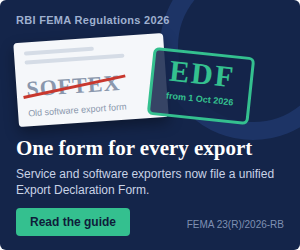
For more than two decades, an Indian company shipping goods abroad had to declare every export, a software firm had to file a SOFTEX form, and a consultant, agency or freelancer billing foreign clients for services had no declaration to file at all. That asymmetry ended on October 1, 2026. The Reserve Bank of India’s Foreign Exchange Management (Export and Import of Goods and Services) Regulations, 2026 are now in force, and with them comes a unified Export Declaration Form (EDF) that covers goods, services and software alike.
This guide explains what changed, who now has to file, the exact deadlines, how the end of SOFTEX affects IT and SaaS exporters, and the practical steps service exporters should take this month to stay compliant.
Key takeaways
- The new Regulations (Notification No. FEMA 23(R)/2026-RB dated January 13, 2026) came into force on October 1, 2026 and supersede the FEMA (Export of Goods & Services) Regulations, 2015.
- A single EDF now covers exports of goods, services and software. The separate SOFTEX form is retired.
- Every service exporter, including freelancers and consultants, must file an EDF within 30 days from the end of the month in which the invoice is raised. One EDF per month can cover all clients.
- Your AD bank is now the primary filing authority for services; software exporters can file with the AD bank or STPI.
- After the September 22, 2026 amendment, export proceeds must be realised within 9 months (12 months if invoiced or settled in INR).
In this article
- What are the FEMA Export and Import Regulations, 2026?
- Why service exporters are affected for the first time
- Old regime vs new regime at a glance
- Who files the EDF, and with whom
- EDF filing deadlines with examples
- The end of SOFTEX: what IT and SaaS exporters must know
- Freelancers and small exporters
- Realisation timelines after the September 2026 amendment
- Other important changes
- Compliance checklist
- FAQs
What are the FEMA (Export and Import of Goods and Services) Regulations, 2026?
The RBI notified the Regulations on January 13, 2026 under Sections 7, 8, 10(6) and 47(2) of the Foreign Exchange Management Act, 1999. They were published in the Official Gazette on January 15, 2026, and the RBI issued accompanying Directions on Export and Import of Goods and Services on January 16, 2026. The Regulations were given a long runway and took effect on October 1, 2026.
They replace the FEMA (Export of Goods & Services) Regulations, 2015 along with the long-standing Master Directions on export and import. As the new name suggests, export and import are now handled in a single framework rather than separate rulebooks.
The philosophy behind the overhaul is clear: fewer approvals from the RBI, more decision-making by Authorised Dealer (AD) banks, and one consistent reporting trail for every rupee of foreign exchange earned from exports. A first amendment was notified on September 22, 2026, shortly before the go-live date, and it materially changed the realisation timelines discussed below.
Why service exporters are affected for the first time
Under the 2015 framework, only two categories of exporters had to declare their exports: goods exporters (through the EDF or the shipping bill) and software exporters (through SOFTEX). A management consultant in Pune, a design agency in Jaipur, a BPO in Noida or a chartered accountant serving a client in Dubai filed nothing equivalent. The bank simply received the inward remittance with a purpose code.
The 2026 Regulations close that gap. Regulation 3(2) requires every exporter of services to declare the full export value of services in the EDF. The definition of services expressly includes software, which is how SOFTEX gets absorbed into the same system.
There is no minimum threshold and no carve-out for individuals. If you raise an invoice to a client outside India for a service, you are an exporter of services under FEMA, and the EDF obligation applies.
Old regime vs new regime at a glance
| Area | Up to Sept 30, 2026 (2015 Regulations) | From Oct 1, 2026 (2026 Regulations) |
|---|---|---|
| Export of goods | EDF / shipping bill, with exemptions for no-forex and personal exports | EDF for all goods; exports without consideration declared at nil value |
| Export of services | No declaration required | EDF mandatory, within 30 days from end of invoice month |
| Export of software | SOFTEX form, certified by STPI / SEZ | SOFTEX retired; EDF filed with AD bank or STPI |
| Monthly consolidation | Limited | One EDF can cover all service exports of a month |
| Goods vs services set-off | Not permitted | Permitted with same counterparty or its group / associate companies |
| Approving authority | Many cases required RBI approval | AD banks decide most matters under their own board-approved SOP |
Who files the EDF, and with whom
The Regulations define a “specified authority” for each type of export. This is the body that receives and authenticates your EDF.
| Type of export | Domestic Tariff Area (DTA) | Special Economic Zone (SEZ) |
|---|---|---|
| Goods | Commissioner of Customs | Development Commissioner, SEZ |
| Services (other than software) | Authorised Dealer bank | Development Commissioner, SEZ |
| Software | Authorised Dealer bank or STPI | Development Commissioner, SEZ |
For most service businesses in the DTA, this means your EDF goes to the same AD bank that receives your foreign remittances. Where the EDF is filed with an authority other than an AD bank (for example STPI or an SEZ), that authority forwards the authenticated form to the AD bank. The bank then records the EDF in the Export Data Processing and Monitoring System (EDPMS) within five working days.
EDF filing deadlines with examples
Goods
The EDF must be furnished at the time of export. For shipments through an Electronic Data Interchange (EDI) port, the EDF is treated as submitted as part of the shipping bill, so most goods exporters will not notice a procedural change. Travellers carrying personal effects are not treated as exporters.
Services and software
The EDF must be filed within 30 days from the end of the month in which the invoice was raised. Three flexibilities apply:
- Monthly consolidation: if you invoiced several overseas clients in a month, a single EDF can cover all of those exports.
- Early filing for non-software services: exporters of services other than software may file the EDF on or before the date the payment is received.
- Extension: the AD bank can extend the filing deadline on a request that explains the reason for delay, if it finds the reason reasonable.
Worked example
A Jaipur-based digital agency raises three invoices in October 2026: to a UK client on October 5, a US client on October 18 and a Singapore client on October 29.
The month ends on October 31, so a single EDF covering all three invoices must reach the AD bank by November 30, 2026. Alternatively, the agency could file an EDF for each invoice as and when the client pays.
The end of SOFTEX: what IT and SaaS exporters must know
SOFTEX was created to track foreign exchange earned from off-site software exports. Exporters generated a SOFTEX number, filed invoice-level details on the STPI or SEZ system, and waited for certification before the bank could close the export entry. For high-volume SaaS and IT services businesses, it was one of the most paperwork-heavy parts of FEMA compliance.
From October 1, 2026, the SOFTEX form no longer exists as a separate mechanism. Software exports are reported in the same EDF used for every other export. Two practical changes stand out:
- Choice of authority: DTA software exporters can now file with their AD bank instead of going through STPI, although STPI remains available as a specified authority. SEZ units continue to deal with the Development Commissioner.
- Monthly rhythm: the “30 days from end of invoice month” rule and monthly consolidation apply to software too, aligning software reporting with your monthly GST and accounting close.
Companies that built internal processes around SOFTEX numbers, STPI certification queues and SOFTEX-based EDPMS closure should rework those workflows, update ERP fields, and confirm with their bank which channel and format it expects for software EDFs.
Freelancers and small exporters
Freelancers have been the group most surprised by the change. Developers, writers, designers, tutors and consultants paid through bank transfer, PayPal, Payoneer, Wise or similar channels are exporters of services under FEMA, and the EDF requirement applies to them too.
The Regulations do offer real relief for smaller invoices. Where an invoice is up to ₹10 lakh (or the foreign currency equivalent):
- the bank can close the EDPMS entry on the basis of the exporter’s own declaration that payment has been realised, in full or otherwise;
- that declaration can be submitted quarterly for bulk closure of entries; and
- a reduction in export value, or non-realisation, can be accepted on the exporter’s declaration.
For a freelancer, the realistic routine is one consolidated EDF per month and one quarterly realisation declaration to the bank. Ask your bank or payment platform whether it offers a digital EDF submission flow, because the operational process will differ from provider to provider.
Realisation timelines after the September 2026 amendment
The original January 2026 notification gave exporters a generous 15 months to realise and repatriate export proceeds (18 months for INR transactions). The amendment notified on September 22, 2026 pulled those periods back before the rules went live. The timelines now in force are:
| Situation | Realisation period | Counted from |
|---|---|---|
| Goods (other than to an overseas warehouse) | 9 months | Date of shipment |
| Services and software | 9 months | Date of invoice |
| Goods exported to an overseas warehouse | 9 months | Date of sale from the warehouse |
| Exports invoiced or settled in INR | 12 months | Shipment, invoice or warehouse sale, as applicable |
| Project exports | As per contract | Payment terms of the contract |
AD banks may extend these periods on a reasoned request. Set-off against import payables, discussed below, counts as realisation. Several early explainers published in the first half of 2026 still quote the 15-month figure, so make sure internal policies reflect the amended position.
Other important changes
Set-off of export receivables against import payables
AD banks may allow export receivables to be set off against import payables with the same overseas buyer or supplier, or with its overseas group or associate companies, within the realisation period. Crucially, goods receivables can now be set off against services payables and vice versa, which was not allowed earlier.
Third-party receipts and payments
Banks can permit export proceeds to be received from, or import payments made to, a third party once they are satisfied that the transaction is bona fide.
Consequence of long-unrealised exports
If proceeds stay unrealised for more than one year beyond the due date (or extended date), the exporter can make further exports only against full advance payment or an irrevocable letter of credit. Exporters already on the RBI Caution List as on September 30, 2026 remain governed by the existing order until they are removed from it.
Stronger accountability for banks
Each AD bank must adopt a written policy and Standard Operating Procedure covering documents, timelines, charges, extensions, write-offs, advances and factoring, and publish its main features on its website. Charges must be reasonable, and banks cannot levy penalties or charges on customers for regulatory delays or violations. There must also be an internal appeal mechanism for customer grievances.
Legacy cases moved to banks
Export and import transactions undertaken before October 1, 2026 that would earlier have required RBI approval will now be handled by AD banks. This should speed up the clean-up of old outstanding EDPMS and IDPMS entries.
Compliance checklist for service and software exporters
- Map every foreign invoice. List all clients outside India and confirm which invoices were raised on or after October 1, 2026.
- Speak to your AD bank now. Ask how it accepts service EDFs (portal, internet banking module or physical form), what supporting documents it wants, and where its SOP is published.
- Fix a monthly calendar. Treat the 30th day after month-end as a hard deadline and file one consolidated EDF per month.
- Align invoice data. Make sure invoice numbers, dates, currencies and values match across your EDF, GST return (Table 6A of GSTR-1 for zero-rated exports) and books. Mismatches are the most likely trigger for bank queries.
- Track realisation. Monitor every invoice against the 9-month window (12 months for INR) and request extensions before the deadline, not after.
- Use the ₹10 lakh relief. For invoices up to ₹10 lakh, file realisation declarations quarterly for bulk EDPMS closure.
- Retire SOFTEX workflows. Software exporters should update ERP fields, internal SOPs and STPI-related processes, and decide whether to file through the bank or STPI.
- Keep evidence ready. Retain contracts, statements of work, invoices, FIRCs or bank advices and client correspondence for every export.
Why non-compliance matters
A contravention of FEMA regulations can attract a penalty under Section 13 of FEMA of up to three times the sum involved where it is quantifiable, or up to ₹2 lakh where it is not, plus up to ₹5,000 for every day the contravention continues. Unreported or unrealised exports can also block future advances and complicate compounding later. Filing on time costs far less than fixing it afterwards.
Frequently asked questions
When did the FEMA Export and Import Regulations, 2026 come into force?
They came into force on October 1, 2026. They were notified on January 13, 2026 and amended on September 22, 2026.
Is SOFTEX still required for software exports?
No. The separate SOFTEX form has been retired. Software exports are now declared in the unified EDF, filed with the AD bank or STPI in the DTA, or with the Development Commissioner in an SEZ.
Do freelancers need to file an EDF?
Yes. Services provided to clients outside India are exports of services under FEMA, and the Regulations do not set a minimum threshold or exempt individuals. A single EDF per month can cover all foreign clients.
What is the deadline to file an EDF for services?
Within 30 days from the end of the month in which the invoice was raised. Exporters of services other than software can also file on or before the date of receiving payment, and the AD bank can extend the deadline for genuine reasons.
How long do I have to realise export proceeds?
Nine months from the invoice date for services and from the shipment date for goods, or twelve months where the export is invoiced or settled in Indian Rupees. These figures reflect the September 22, 2026 amendment, which replaced the earlier 15 and 18 month periods.
Does the EDF replace GST compliance for exports?
No. The EDF is a FEMA requirement administered through banks and the RBI. GST obligations for zero-rated exports, such as filing under LUT and reporting in GSTR-1, continue separately. The two should, however, carry consistent invoice data.
Is there any relief for small invoices?
Yes. For invoices up to ₹10 lakh, banks can close EDPMS entries and accept reduced or non-realisation on the exporter’s own declaration, which may be submitted quarterly in bulk.
Conclusion
The unified Export Declaration Form is the biggest procedural change for Indian service exporters in a generation. It removes the SOFTEX bottleneck for software companies, gives banks wider authority, and offers sensible relief for small invoices, but it also brings consultants, agencies, BPOs and freelancers into a formal reporting system for the first time.
The first EDFs under the new regime, for invoices raised in October 2026, fall due by November 30, 2026. Exporters who set up their monthly filing routine with their bank this month will find the transition straightforward.
Source: RBI Notification No. FEMA 23(R)/2026-RB dated January 13, 2026, as amended by Notification No. FEMA 23(R)/(1)/2026-RB dated September 22, 2026, available on the Reserve Bank of India website.
Disclaimer: This article is for general information only and does not constitute legal or professional advice. Bank-level procedures for EDF submission may vary. Please consult your AD bank or a qualified professional before acting.
